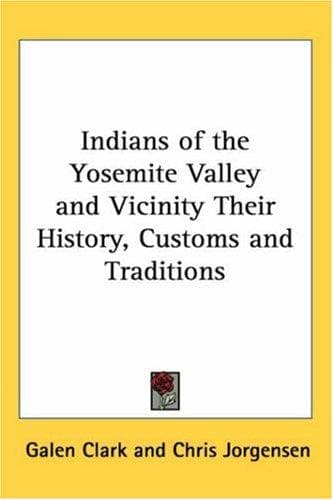
Indians of the Yosemite valley and vicinity: Their history, customs and traditions — John Shaqi
Indians of the Yosemite valley and vicinity: Their history, customs and traditionsClark, Galen
History
Indians of the Yosemite valley and vicinity: Their history, customs and traditions
Clark, Galen
Indians of North America -- California; Yosemite Valley (Calif.)
With the first streak of dawn she bounded swiftly up the rough
canyon, for she was fully convinced that some terrible fate had
overtaken the brave Kos-su'-kah, and soon she stood upon the
lofty summit [Yosemite Point], where she found her lover's
footsteps leading towards the edge of the precipice. Drawing
nearer she was startled to find that a portion of the cliff had
given way, and, upon peering over the brink, what was her horror
to discover the blood-stained and lifeless body of Kos-su'-kah
lying on a rocky ledge far beneath.
Summoning assistance by means of a signal fire, which was seen
from the Valley below, a rope was made of sapling tamaracks
lashed firmly together with thongs from one of the deer that was
to have furnished the marriage feast, and Tee-hee'-nay herself
insisted on being lowered over the precipice to recover the body
of her lover. This was at last successfully accomplished, and
when his ghastly form lay once more upon the rocky summit, she
threw herself on his bosom and gave way to passionate outburst of
grief.
Finally she became quiet, but when they stooped to raise her they
found that her spirit had fled to join the lost Kos-su'-kah and
that the lovers were re-united in death!
The fateful arrow that was the cause of so much sorrow could
never be found, and the Indians believe that it was taken away by
the spirits of Kos-su'-kah and Tee-hee'-nay. In memory of
them, and of this tragedy, the slender spire of rock [sometimes
called "The Devil's Thumb"] that rises heavenward near the top of
the cliff at this point is known among the Indians as Hum-mo',
or the Lost Arrow.
Appendix
HINTS TO YOSEMITE VISITORS.
Secure stage seats in advance.
Take only hand baggage, unless for a protracted visit. For a
short trip, an outing suit and two or three waists, with a change
for evening wear, will be found sufficient. The free baggage
allowance on the stage lines is fifty pounds.
Men will find flannel or negligee shirts the most comfortable.
In April, May and June wear warm clothing and take heavy wraps.
In July, August and September wear medium clothing, with light
wraps. In October and November wear warm clothing, with heavy
wraps. The nights are cool at all seasons.
Dusters are always advisable, and ladies should provide some
light head covering to protect the hair from dust. Sun bonnets
are frequently worn.
Short skirts are most convenient.
Divided skirts are proper for trail trips, as ladies are required
to ride astride. Heavy denim for skirt and bloomers is very
satisfactory. Such skirts can be hired in the Valley.
Waists of soft material and neutral shades are appropriate. Avoid
white.
Something absolutely soft for neckwear will be found a great
comfort, both by men and women.
Leggings, stout, comfortable shoes, and heavy, loose gloves, will
be found very serviceable.
A soft felt hat is preferable to straw. One that will shade the
eyes is best. A cloth traveling cap is the worst thing to wear.
Public-domain text, read in full here on John Shaqi.
Reviews
Reviews
No reviews yet
Be the first to share your thoughts on this work.
Join the Discussion
Join the discussion
Sign in to leave a comment or review.
Sign InorCreate an account