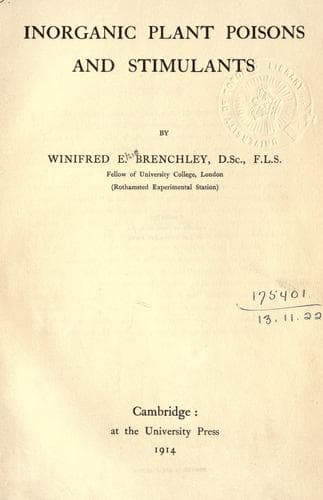
Inorganic Plant Poisons and StimulantsBrenchley, Winifred Elsie
Science
Inorganic Plant Poisons and Stimulants
Brenchley, Winifred Elsie
Growth (Plants); Plants -- Effect of poisons on
Another method of water cultures is used by some investigators, in which
the experiments only last for a few hours or days, usually 24–48 hours.
While such experiments may not be without value for determining the
broader outlines of toxic poisoning, they fail to show the finer details.
The effect of certain strengths of poison is not always immediate. Too
great concentrations kill the plant at once, too weak solutions fail
to have any appreciable immediate action and so appear indifferent.
Between the two extremes there exists a range of concentrations of which
the effect varies with the plant’s growth. A solution may be of such a
nature and strength that at first growth is seriously checked, though
later on some recovery may be made, while it is also possible that a
concentration which is apparently indifferent at first may prove more
or less toxic or stimulant at a later date, according to circumstances.
Consequently too much stress must not be laid upon the results of the
short time experiments with regard to the ultimate effect of a poison upon
a particular plant.
* * * * *
An examination of the various experimental methods shows that while no
one of them is ideal, yet each of them has a definite contribution to make
to the investigation of toxic and stimulant substances. Each method aids
in the elucidation of the problem from a different standpoint, and the
combination of the results obtained gives one a clearer picture of the
truth than could be obtained by one method alone. Water cultures, with
their exactitude of quantitative control lead on by way of sand cultures
to pot cultures, and these to field experiments in which the control is
largely lost, but in which the practical application is brought to the
front.
CHAPTER III
EFFECT OF COPPER COMPOUNDS
I. PRESENCE OF COPPER IN PLANTS.
Copper has been recognised as a normal constituent of certain plants
for at least a century, so much so that in 1816 Meissner brought out
a paper dealing solely with the copper content of various plant ashes.
The ash of _Cardamomum minus_, of the root of _Curcuma longa_, and of
“Paradieskörner[3],” amongst others, were tested and all yielded copper
in very small quantity. Meissner was led to conclude that copper is
widespread in the vegetable kingdom, but that it exists in such minute
traces that its determination in plants is exceedingly difficult. In 1821
Phillips made an interesting observation as to the effect of copper on
vegetation. Some oxide of copper was accidentally put near the roots of a
young poplar, and soon after the plant began to fail. The lower branches
died off first, but the harm gradually spread to the topmost leaves. As
a proof that copper had been absorbed by the plant the record tells that
the blade of a knife with which a branch was severed was covered with a
film of copper where it had been through the branch, and the death of the
plant was attributed to the absorbed copper.
Public-domain text, read in full here on John Shaqi.
Reviews
Reviews
No reviews yet
Be the first to share your thoughts on this work.
Join the Discussion
Join the discussion
Sign in to leave a comment or review.
Sign InorCreate an account