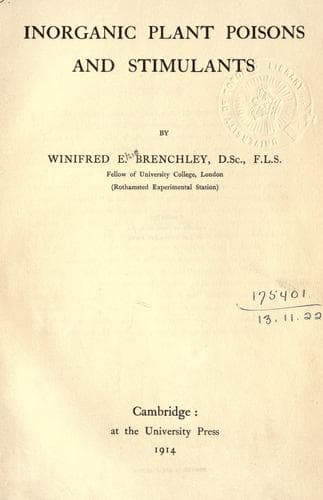
Inorganic Plant Poisons and StimulantsBrenchley, Winifred Elsie
Science
Inorganic Plant Poisons and Stimulants
Brenchley, Winifred Elsie
Growth (Plants); Plants -- Effect of poisons on
[3] These are “grains of Paradise,” Guinea grains, or meleguetta
pepper. They are the seeds of _Amomum melegueta_ and _A.
Granum-Paradisi_, N.O. Zingiberaceae.
After this preliminary breaking of the ground little more seems to have
been done for some sixty years, but from about 1880 till the present day
the association of copper with the vegetable kingdom has been actively
investigated in its many aspects. Dieulafait (1880) showed that the
quantity of copper present in the vegetation is largely determined by the
nature of the soil, which thus affects the ease with which the element can
be detected and estimated. Copper was shown to exist in all plants which
grow on soils of “primary origin” (“roches de la formation primordiale”),
the proportion being sufficient to enable it to be recognised with
certainty in one gram of ash, even by means of the ammonia reaction.
Samples of white oak from the clay soils, and plants from the dolomitic
horizons also gave evidence of copper in one gram of ash, though less
was present than in the first case considered, but with plants grown on
relatively pure chalk 100 grams of ash had to be examined before copper
could be recognised with certainty.
E. O. von Lippman found traces of copper in beets, beet leaves, and beet
products; Passerini estimated as much as ·082% copper in the stem of
chickpea plants, though he regarded this figure as too high; Hattensaur
determined ·266% CuO in the total ash of _Molinia cærulea_ (·006% of total
plant, air-dried).
After this Lehmann (1895, 1896) carried out more exhaustive studies on
the subject of detecting and estimating the copper in various articles
of food: wheat, rye, barley, oats, maize, buckwheat, and also in various
makes of bread; potatoes, beans, linseed, salads, apricots and pears;
cocoa and chocolate. He found that only in those plants which are grown
on soil rich in copper does the copper reach any considerable value, a
value which lies far above the quantity present in an ordinary soil.
Plants from the former soils contained as much as 83–560 mg. Cu in 1
kilog. dry substance, whereas ordinarily the plants only contained from
a trace to 20 mg. Apparently the species of the plants concerned seems
to be of less importance for their copper content than is the copper
content of the soil. The deposition of copper (in wheat, buckwheat and
paprika) is chiefly in the stems and leaves, little being conveyed to the
fruits and seeds, so that a high content of copper in the soil does not
necessarily imply the presence of much copper in the grain and seed. The
metal is variously distributed among the tissues, the bark of the wood
being the richest of the aerial parts in that substance. The form in which
the copper exists in the plant is uncertain and it is suggested that an
albuminous copper compound possibly exists.
Public-domain text, read in full here on John Shaqi.
Reviews
Reviews
No reviews yet
Be the first to share your thoughts on this work.
Join the Discussion
Join the discussion
Sign in to leave a comment or review.
Sign InorCreate an account