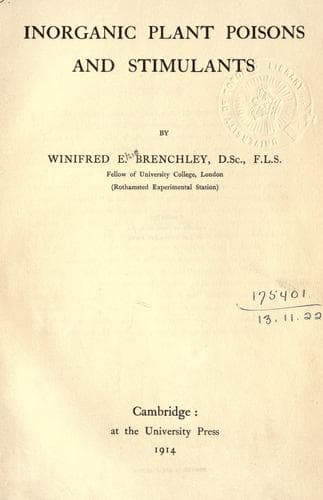
Inorganic Plant Poisons and Stimulants — John Shaqi
Inorganic Plant Poisons and StimulantsBrenchley, Winifred Elsie
Science
Inorganic Plant Poisons and Stimulants
Brenchley, Winifred Elsie
Growth (Plants); Plants -- Effect of poisons on
Vedrödi (1893) tackled the problem at about the same time as Lehmann but
from a rather different standpoint. He ratifies the statement as to the
absorption of copper by plants, and going still further he states that
in some cases the percentage of copper found in the seed may be four
times as great as that occurring in the soil on which the plants grow,
quoting one instance in which the soil contained ·051% CuO and the seed
·26% CuO. It is assumed that copper must play some physiological rôle in
the plant, but no explanation of this action is yet forthcoming. Lehmann
criticised Vedrödi’s figures of the copper content of certain plant ashes,
and the latter replied in a further paper (1896) in which he brings most
interesting facts to light. The quantity of copper in any species of plant
varies with the individuals of that species, even when grown on the same
soil, in the same year, and under similar conditions. The copper content
of certain plants is put forward as a table, the years 1894 and 1895 being
compared, and enormous differences are to be noticed in some cases. A
quotation of the table will illustrate this more clearly than any amount
of explanation.
_Milligrams of copper in 1 kilog. dry matter._
1894 1895
/ \ / \
“Seeds” min. max. min. max.
Winter wheat 80 710 200 680
Summer wheat 190 630 190 230
Maize 60 90 10 30
Barley 80 120 10 70
Oats 40 190 40 200
Buckwheat 160 640 150 160
“Fisolen” (Beans) 160 320 110 150
Linseed 120 150 110 150
Peas 60 100 60 110
Soy Beans 70 100 70 80
Lupins 80 190 70 290
Mustard seed 70 130 60 70
Paprika pods 790 1350 230 400
II. EFFECT OF COPPER ON THE GROWTH OF HIGHER PLANTS.
1. _Toxic effect._
(_a_) _Toxic action of copper compounds alone in water cultures._
The method of water cultures has been largely applied to determine the
relation of copper compounds to plants. Twenty years ago (1893) Otto
discovered the extreme sensitiveness of plants to this poison when grown
under such conditions, as he found that growth was very soon checked in
ordinary distilled water which on analysis proved to contain minute traces
of copper. Controls grown in tap water gave far better plants, but this
superiority was attributed partly to the minute traces of mineral salts
in the tap water, and not only to the absence of the copper which occurred
in the distilled water.
Public-domain text, read in full here on John Shaqi.
Reviews
Reviews
No reviews yet
Be the first to share your thoughts on this work.
Join the Discussion
Join the discussion
Sign in to leave a comment or review.
Sign InorCreate an account