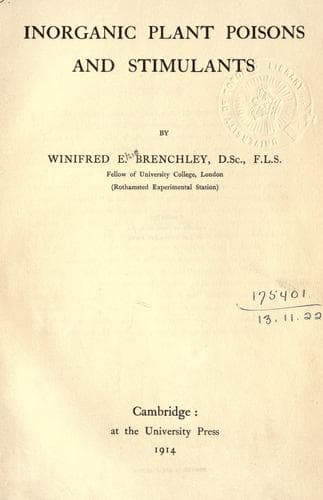
Inorganic Plant Poisons and StimulantsBrenchley, Winifred Elsie
Science
Inorganic Plant Poisons and Stimulants
Brenchley, Winifred Elsie
Growth (Plants); Plants -- Effect of poisons on
Haselhoff (1892) extracted several lots of 25 kgm. soil, each with 25
litres of water in which quantities of mixed copper salts varying from
0–200 mg. had been dissolved, the mixture consisting of three parts copper
sulphate and one part copper nitrate. This operation was repeated 15
times, the soils being allowed to drain thoroughly after each treatment,
so that altogether each 25 kgm. soil was extracted with 375 litres water.
The drainage waters were analysed, so that the amount of copper absorbed
by the soils could be estimated. It was found that by extracting with
water containing such soluble copper salts as sulphate and nitrate, the
food salts of the soil, especially those of calcium and potassium, were
dissolved and washed out, copper oxide being retained by the soil. In
this way a double action was manifest, whereby the fertility of the soil
was reduced by the loss of plant food, while its toxicity was increased
by the accumulation of copper oxide. So long as the soil contained a
good supply of undissolved calcium carbonate the harmful action of the
copper-containing water was diminished, but as soon as the store was
exhausted by solution and leaching, the toxic influence became far more
evident.
(_e_) _Mode of action of copper on plants._
Quite early in the investigations on the effect of copper on plants
the question arose as to its mode of activity--whether the toxicity was
merely due to some mechanical action on the root from outside, whereby
the absorptive power of the root was impaired, or whether the poisonous
substance was absorbed into the plant, so acting directly on the internal
tissues. Gorup-Besanez made definite experiments towards ascertaining the
truth of these theories as far back as 1863, endeavouring first of all to
see whether the plants take up any appreciable quantity of poisons which
exist in the soil as mixtures or combinations and which are capable of
solution by the cell-sap. Salts of arsenic, copper, lead, zinc and mercury
were intimately mixed with soil, 30 grams of the poison being added to
30·7 cubic decimetres of soil, two plants separated by a partition being
grown on this quantity. The test plants were _Polygonum Fagopyrum_,
_Pisum sativum_, _Secale cereale_ and _Panicum italicum_, and all the
plants developed strongly and normally except the last named. The Panicum
developed very badly coloured leaves in an arsenic-containing soil, and
the plants were killed soon after they started in soils containing copper.
After harvesting, the crops were analysed and no trace of copper was found
in any one of the experimental plants by the methods adopted. Also the
absorption capacity of different soils for different poisons was shown
to vary, for basic salts are absorbed, while acids may pass completely
through the soil into the drainage water.
Public-domain text, read in full here on John Shaqi.
Reviews
Reviews
No reviews yet
Be the first to share your thoughts on this work.
Join the Discussion
Join the discussion
Sign in to leave a comment or review.
Sign InorCreate an account