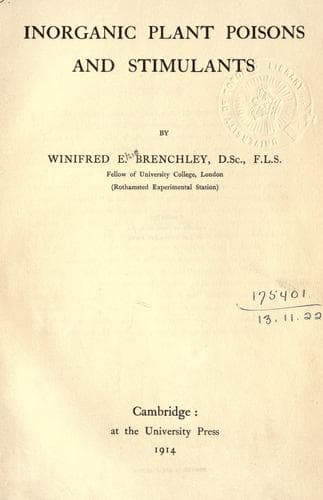
Inorganic Plant Poisons and StimulantsBrenchley, Winifred Elsie
Science
Inorganic Plant Poisons and Stimulants
Brenchley, Winifred Elsie
Growth (Plants); Plants -- Effect of poisons on
These results obtained by Gorup-Besanez are possibly not altogether above
criticism, for later workers showed that copper was absorbed to some
extent by plants grown in water cultures, and if that is so it seems
unlikely that no absorption should take place from soil. Nevertheless,
the absorption is very slight, for apparently living protoplasm is
very resistant to copper osmotically. Otto showed that beans, maize and
peas can have their roots for a long time in a relatively concentrated
solution of copper sulphate, and yet take up very little copper indeed,
but analyses do reveal slight traces after a sufficient interval of time
of contact has elapsed. Berlese and Sostegni indicate that the roots of
plants grown in water culture in the presence of bicarbonate of copper
showed traces of copper.
Verschaffelt (1905) devised an ingenious method of estimating the
toxic limits of plant poisons, though it is rather difficult to see
how the method can be put to practical use with water culture and soil
experiments. Living tissues increase in weight when put into water on
account of the absorption of water. Dead tissues do not, as they have
lost their semi-permeable characteristics, so a decrease in weight takes
place owing to part of the water passing out. This principle is applied by
Verschaffelt to determine the “mortal limit” of external agents in their
action on plant tissues. Root of beetroot, potato tuber, aloe leaves,
and parts of other plants rich in sugar all came under review. The parts
were cut into small pieces weighing about 3–5 grams, dried with filter
paper, weighed, and plunged into solutions of copper sulphate of varying
strengths from ·001–·004 gm. mol. per litre, and left for 24 hours. After
drying and again weighing all were heavier owing to the absorption of
water. The pieces were then immersed in pure water for another period of
24 hours, when after drying and weighing, those from the weaker strengths
of copper sulphate (·001–·002) had absorbed yet more water, while those
from higher concentrations (·003–·004) had lost weight. So the author
assumes that for such pieces of potato the limit of toxicity lies between
·002 and ·003 gm. mol. copper sulphate per litre.
Public-domain text, read in full here on John Shaqi.
Reviews
Reviews
No reviews yet
Be the first to share your thoughts on this work.
Join the Discussion
Join the discussion
Sign in to leave a comment or review.
Sign InorCreate an account