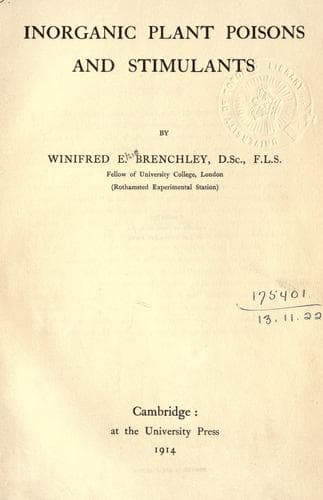
Inorganic Plant Poisons and StimulantsBrenchley, Winifred Elsie
Science
Inorganic Plant Poisons and Stimulants
Brenchley, Winifred Elsie
Growth (Plants); Plants -- Effect of poisons on
The bulk of the work on the relations of copper with the life-processes
of plants has dealt with those cases in which the metal has been supplied
to the roots in some form or other, and many of the results may be
said to apply more strictly to the theoretical, or rather to the purely
scientific aspects of the matter, than to the practical everyday life
of the community. This statement is hardly correct, in that the two
lines of work are so inextricably interwoven that the one could not be
satisfactorily followed up without a parallel march of progress along the
other. In practice, copper has proved remarkably efficient as a fungicide
when applied as sprays in the form of Bordeaux mixture to infested plants
and trees. Observations on the action of the fungicide have shown that
the physiological processes of the treated plants are also affected to
some degree, and a number of interesting theories and results have been
put forward.
(_a_) _Effect of copper sprays on leaves._
Frank and Krüger (1894) treated potato plants with a 2% Bordeaux mixture,
and obtained a definite improvement in growth, which they attributed
to the direct action of the Bordeaux mixture upon the activities of
the plant. The effect of the copper was most marked in the leaves,
and was chiefly indicated by increase in physiological activity rather
than by morphological changes. The structure of the sprayed leaves was
not fundamentally changed but they were thicker and stronger in some
degree, while their life was lengthened. Apparently, treatment increased
the chlorophyll content, and, correlated with this, was a rise in the
assimilatory capacity, more starch being produced. Rise in transpiration
was also observed. While the leaves were the organs most affected, a
subsidiary stimulation occurred in the tubers, since the greater quantity
of starch produced required more accommodation for its storage. In
different varieties the ratio of tuber formation on treated and untreated
plants was 19:17 and 17:16. In discussing the meaning of this stimulation
these writers, following the custom then in vogue, were inclined to
hold that it was due to a catalytic rather than to a purely chemical
action, an idea similar to one which later on came much into prominence
in connection with the work of Bertrand’s school on manganese, boron and
other substances.
The imputed increase in photo-synthesis seems to have met with approval
and acceptance, but nevertheless it did not pass unchallenged. Ewert
(1905) brought forward a detailed discussion and criticism of the
assumption that green plants when treated with Bordeaux mixture attain a
higher assimilation activity than untreated plants. His experiments were
made to test the effects of differing conditions of life on plants treated
in various ways, and his conclusions lead him to assert that “instead of
the organic life of the plant being stimulated by treatment with Bordeaux
mixture it is rather hindered.”
Public-domain text, read in full here on John Shaqi.
Reviews
Reviews
No reviews yet
Be the first to share your thoughts on this work.
Join the Discussion
Join the discussion
Sign in to leave a comment or review.
Sign InorCreate an account