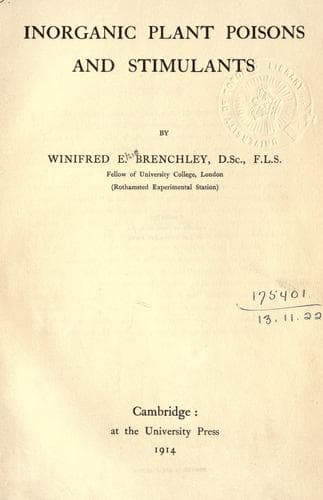
Inorganic Plant Poisons and StimulantsBrenchley, Winifred Elsie
Science
Inorganic Plant Poisons and Stimulants
Brenchley, Winifred Elsie
Growth (Plants); Plants -- Effect of poisons on
While Frank and Krüger indicated a rise in transpiration when copper
compounds were applied to the _leaves_ as sprays, Hattori (1901)
attributed part of the toxic effect of copper salts, when applied to
the _roots_, to a weakening action on the transpiration stream, and
he maintained that the toxic effect of the copper salts is therefore
connected with the humidity of the air. No further confirmation or
refutation of this statement has so far come to light.
In certain plants the application of cupric solutions as sprays causes a
slight increase in the quantity of sugar present in the matured fruits.
Chuard and Porchet (1902, 1903) consider that such a modification in the
ripe fruit during the process of maturation occurs in all plants which
ripen their fruits before leaf-fall begins. Injection of solutions of
copper salts into the tissues of such plants as the vine causes more
vigorous growth, more intense colour and greater persistence of the
leaves; in other words the copper acts as a stimulant to all the cells of
the organism. A similar effect is produced by other metals such as iron or
cadmium. By injecting small quantities of cupric salts into the branches
of currants an acceleration of the maturation of the fruits was caused,
identical with that obtained by the application of Bordeaux mixture to the
leaves. If the quantity of copper introduced into the vegetable organism
was augmented, the toxic action of the metal began to come into play.
These investigators attributed the stimulus, as shown by the earlier
maturation of the fruits, to a greater activity of all the cells of
the organism and not to an excitation exercised only on the chlorophyll
functions.
(_b_) _Effect of solutions of copper salts on leaves._
Treboux (1903) demonstrated the harmful action of solutions of copper
salts on leaves by means of experiments on shoots of _Elodea canadensis_.
The activity of photo-synthesis was measured by the rate of emission
of bubbles of oxygen. On placing the shoots first in water, then in
_N_/1,000,000 copper sulphate (·0000159%), there was a reduction from
20 to 15 or 16 bubbles in 5 minutes. On replacing in water there was
an increase to 18, but not to 20, indicating a permanent injury. With
_N_/10,000,000 copper sulphate there was little or no reduction in the
number of bubbles. This experiment had an interesting side issue in that
it was noticed that not only the concentration, but also the quantity
of fluid was concerned in the toxic action, indicating that both the
proportion and the actual amount of poison available play their part.
For instance, with a shoot 10 cm. long in 100 c.c. solution the plants
were only slightly affected by ·000015% copper sulphate, but in 500
c.c. solution the shoots were killed after some days in ·0000015% copper
sulphate, a concentration only one-tenth as great.
Public-domain text, read in full here on John Shaqi.
Reviews
Reviews
No reviews yet
Be the first to share your thoughts on this work.
Join the Discussion
Join the discussion
Sign in to leave a comment or review.
Sign InorCreate an account