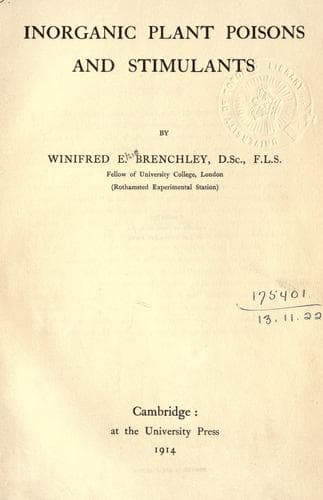
Inorganic Plant Poisons and StimulantsBrenchley, Winifred Elsie
Science
Inorganic Plant Poisons and Stimulants
Brenchley, Winifred Elsie
Growth (Plants); Plants -- Effect of poisons on
On turning to the lower plants, especially to some species of fungi,
one notices a striking contrast in their behaviour to that of the higher
plants. Some species of fungi have the power of living and flourishing
in the presence of relatively large quantities of copper compounds, or
even of copper or bronze in the solid state. Dubois (1890) found that
concentrated solutions of copper sulphate, neutralised by ammonia, which
were used for the immersion of gelatine plates used in photography,
showed white flocculent masses resembling the mycelium of Penicillium
and Aspergillus, which grew rapidly and fructified in Raulin’s solution,
but which remained as mycelium in cupric solutions. The mould proved
capable of transforming copper sulphate into malachite in the presence of
a piece of bronze, but it was found that the presence of the latter was
not essential for the conversion into basic carbonate. The same result
was obtained if the culture liquid was put in contact with a body which
prevented it from becoming acid, fragments of marble acting in this way.
Copper sulphate solution in the presence of the mould produced a _green_
deposit on the marble, while without the fungus the solution simply
evaporated leaving a blue stain of copper sulphate.
Trabut (1895) found that on treating smutty wheat with a 2% solution of
copper sulphate he obtained a mass of flocculent white mycelium, whose
surface was soon covered with aerial branches bearing pale rose-coloured
spores, and he gave the provisional name of _Penicillium cupricum_ to the
species. On preparing nutritive solutions by steeping a handful of wheat
in water for 24 hours, and then adding various amounts of copper sulphate
to them, Penicillium was found to vegetate quite well until the amount of
copper sulphate reached 9½ grams in 100 c.c., after which the seedings
with spores did not develope at all. De Seynes tested this Penicillium
more exhaustively with different culture media under various conditions
and decided that Trabut was right in only assigning the name _P. cupricum_
provisionally, as the mould reverts to the form _P. glaucum_ when seeded
in a natural medium, indicating that _P. cupricum_ has not an autonomous
existence, but is _P. glaucum_ which modifies the colour of its conidia
under the influence of copper sulphate, in the same way that it often
modifies them in other media. It is noticeable that the mycelium arising
from the germination of conidia of _P. cupricum_ in a normal medium has a
very poor capacity for producing reproductive organs, but this diminished
activity is attributed not to a special deleterious action of the copper
sulphate but to the impulse given to the vegetative functions, at the
expense of the reproductive, when the spores are seeded in a richer medium
than the solutions of copper sulphate which serve as the soil for _P.
cupricum_.
Public-domain text, read in full here on John Shaqi.
Reviews
Reviews
No reviews yet
Be the first to share your thoughts on this work.
Join the Discussion
Join the discussion
Sign in to leave a comment or review.
Sign InorCreate an account