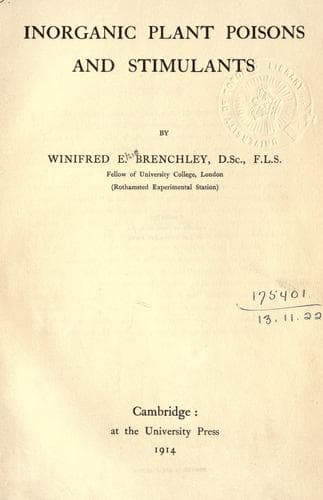
Inorganic Plant Poisons and Stimulants — John Shaqi
Inorganic Plant Poisons and StimulantsBrenchley, Winifred Elsie
Science
Inorganic Plant Poisons and Stimulants
Brenchley, Winifred Elsie
Growth (Plants); Plants -- Effect of poisons on
While it is evident that copper sprays have a definite action upon
green leaves, whether favourable or unfavourable, the question arises
as to the means whereby the copper obtains access to the plant in order
to take effect. Dandeno found that solutions of copper sulphate were
absorbed by the leaves of Ampelopsis, forming a brown ring. Generally
speaking inorganic salts in solution are absorbed through both surfaces
of the leaves, whether the leaves are detached or not, provided the
surrounding atmospheric conditions are favourable, the absorption being
usually more ready through the lower surface. Dilute solutions applied
in drops stimulate the leaf tissue in a ring, whereas if the solutions
are concentrated the entire area covered by the drop is affected. Too
concentrated solutions of copper sulphate applied to leaves caused
scorching, but if this was avoided while the solution was still strong
enough to cause a darkening of green colour after a time, Dandeno
considered that the action was probably of the nature of a stimulus to
growth, and produced a better development of chlorophyll and protoplasm in
the region where the tissues appeared dark to the naked eye, a conclusion
which tallies very closely with that of Frank and Krüger.
Amos (1907–8) experimented to see whether the application of Bordeaux
mixture affected the assimilation of carbon dioxide by the leaves of
plants, and whether any stimulation was produced. Brown and Escombe’s
methods and apparatus were used and the summarised results indicate that
the application of Bordeaux mixture to the leaves of plants diminishes
the assimilation of carbon dioxide by those leaves for a time. The
effect gradually passes off, whatever the age of the leaves may be.
The suggestion is made that the stomata are blocked by the Bordeaux
mixture, so that less air diffuses into the intercellular spaces and less
carbon dioxide comes into contact with the absorptive surfaces. If this
hypothesis is correct, the physiological slackening of assimilation is
not due to the toxic action of the copper in the Bordeaux mixture, but to
a mechanical hindrance due to blocking of the stomata.
III. EFFECT OF COPPER ON CERTAIN OF THE LOWER PLANTS.
Public-domain text, read in full here on John Shaqi.
Reviews
Reviews
No reviews yet
Be the first to share your thoughts on this work.
Join the Discussion
Join the discussion
Sign in to leave a comment or review.
Sign InorCreate an account