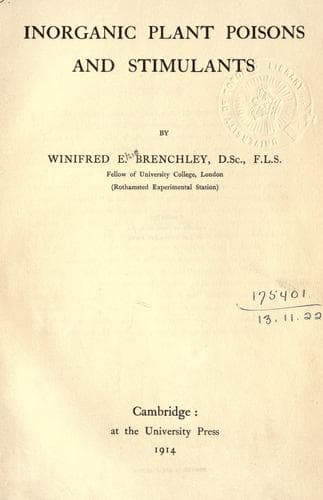
Inorganic Plant Poisons and StimulantsBrenchley, Winifred Elsie
Science
Inorganic Plant Poisons and Stimulants
Brenchley, Winifred Elsie
Growth (Plants); Plants -- Effect of poisons on
The presence of zinc in the ash of certain plants has been recognised for
many years, especially in so far as the vegetation of soils containing
much zinc is concerned. Risse, before 1865, stated that most plants when
grown on such soils prove to contain greater or less quantities of zinc
oxide. He states that the soil at Altenberg, near Aachen, is very rich
in zinc, which rises as high as 20% in places. The flora of the soil
is very diversified and zinc has been determined qualitatively in most
and quantitatively in some of the plants. _Viola tricolor_ and _Thlaspi
alpestre_ are most characteristic under such circumstances, both showing
such constant habit changes that they resemble new species, while other
plants such as _Armeria vulgaris_ and _Silene inflata_ are peculiarly
luxuriant. Risse’s figures of the zinc content of these four plants may
prove of interest. The figures are based on the dry weights, air dried.
_Thlaspi alpestre_, var. _calaminaria_.
Root 6·28% ash, 0·167% ZnO, 1·66% ZnO in ash.
Stem 11·75% „ 0·385% „ 3·28% „ „
Leaves 11·45% „ 1·50% „ 13·12% „ „
Flowers 8·49% „ 0·275% „ 3·24% „ „
_Viola tricolor._
Root 5·59% ash, 0·085% ZnO, 1·52% ZnO in ash.
Stem 10·55% „ 0·065% „ 0·62% „ „
Leaves 9·42% „ 0·110% „ 1·16% „ „
Flowers 7·66% „ 0·075% „ 0·98% „ „
_Armeria vulgaris._
Root 4·74% ash, 0·17% ZnO, 3·58% ZnO in ash.
Stem 5·37% „ 0·02% „ 0·37% „ „
Leaves 9·36% „ 0·11% „ 1·17% „ „
Flowers 6·08% „ 0·07% „ 1·15% „ „
_Silene inflata._
Root 2·71% ash, 0·02% ZnO, 0·74% ZnO in ash.
Stem }
Leaves } 11·43% „ 0·22% „ 1·92% „ „
Flowers }
Freytag (1868) carried out various experiments on the influence of
zinc oxide and its compounds on vegetation, and found that all plants
are capable of absorbing zinc oxide by their roots when grown on soils
containing such oxide. Generally speaking the zinc is deposited chiefly in
the leaves and stems, very little being found in the seeds, such minute
traces occurring that he stated that the seeds must be harmless for men
and animals. The general content of ZnO in plants is given as ·5–1·0% of
ash, except in the abnormal case of plants growing on calamine.
Lechartier and Bellamy (1877) demonstrated the presence of zinc in such
food substances as wheat, American maize, barley and white haricots, but
they failed to find it in maize stems and beetroot, so they cautiously
concluded that if it does occur in the latter cases it must be far less
in quantity than in the former. Hattensaur (1891) analysed the ash of
_Molinia cærulea_ and discovered the presence of copper, manganese, zinc
and lead, zinc oxide forming ·265% of the total ash, (·006% of the air
dried plant).
Public-domain text, read in full here on John Shaqi.
Reviews
Reviews
No reviews yet
Be the first to share your thoughts on this work.
Join the Discussion
Join the discussion
Sign in to leave a comment or review.
Sign InorCreate an account