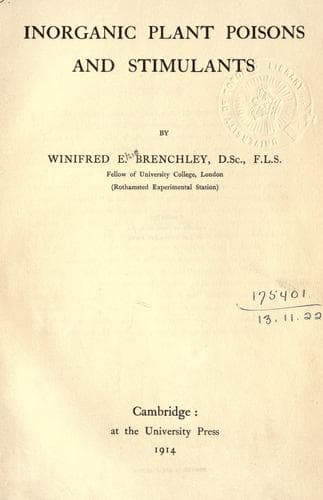
Inorganic Plant Poisons and Stimulants — John Shaqi
Inorganic Plant Poisons and StimulantsBrenchley, Winifred Elsie
Science
Inorganic Plant Poisons and Stimulants
Brenchley, Winifred Elsie
Growth (Plants); Plants -- Effect of poisons on
Jensch (1894) observed that the flora on calamine soils was somewhat
scanty, the chief plants that came under his notice being _Taraxacum
officinale_, _Capsella Bursa-pastoris_, _Plantago lanceolata_, _Tussilago
Farfara_, and _Polygonum aviculare_, all of which showed certain
morphological peculiarities. Generally speaking the growth of these plants
on the calamine soils was weak and poor, the stems and leaves being very
brittle. Jensch found that the roots were deformed and showed a tendency
towards a plate-like superficial spread of root. The leaves of _Tussilago_
were uneven in shape and lacked the white hairs on the under side, the
flower stalks were twisted, while the flowers themselves were a deep
saturated yellow colour. The stems of _Polygonum aviculare_ were much
thickened at the nodes, the leaves weak and rolled in character, while
the flowers were long-stalked, the calyces being usually of a purple
red colour. The following figures are given for the quantities of zinc
carbonate (ZnCO₃) in the ash of these two plants:--
_Tussilago Farfara._
Root Leaf-stalk Leaf-blade
2·51%–3·26% 1·75%–1·63% 2·90%–2·83% ZnCO₃
= 1·629%–2·115% 1·136%–1·058% 1·882%–1·836% ZnO.
_Polygonum aviculare._
Root Stem Leaves
1·77%–1·93% 2·25%–2·86% 1·24%–1·49% ZnCO₃
= 1·148%–1·252% 1·46%–1·856% ·804%–·967% ZnO.
Other analyses of plants from zinc soils as against controls from normal
soils indicated the high water and high ash content of the zinc plants,
though the dry matter was low, and it is suggested that the increase of
the ash may be connected with a stimulation caused by the zinc salts,
unless it is due to phosphoric-acid hunger, since the calamine soils
concerned are very deficient in phosphorus.
Javillier (1908 c) corroborated the early statements of Risse as to the
presence of considerable quantities of zinc in certain species of _Viola_,
_Thlaspi_ and _Armeria_, and also he cited a list of other plants in
which zinc occurs in some quantity. Javillier, however, is of opinion
that zinc oxide, like the oxides of iron and manganese, is very common in
plant ash, being present in all plant organs. Zinc is specially abundant
in Coniferae, where it is probably characteristic, as is the presence
of manganese in the ash and manno-cellulose in the wood. The so-called
“calamine” plants show great powers of accommodation to large amounts of
zinc.
Klopsch (1908) analysed 17 species of plants grown on soil in the
vicinity of zinc works, and showed that the plants evidently absorb small
quantities of zinc from their surroundings. He also regarded zinc as a
normal constituent of certain plants.
II. EFFECT OF ZINC ON THE GROWTH OF HIGHER PLANTS.
1. _Toxic effect._
(_a_) _Toxic action of zinc salts alone in water cultures._
Public-domain text, read in full here on John Shaqi.
Reviews
Reviews
No reviews yet
Be the first to share your thoughts on this work.
Join the Discussion
Join the discussion
Sign in to leave a comment or review.
Sign InorCreate an account