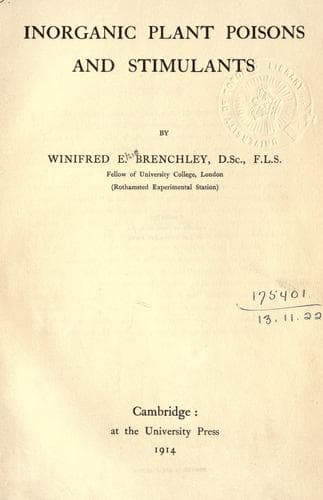
Inorganic Plant Poisons and Stimulants — John Shaqi
Inorganic Plant Poisons and StimulantsBrenchley, Winifred Elsie
Science
Inorganic Plant Poisons and Stimulants
Brenchley, Winifred Elsie
Growth (Plants); Plants -- Effect of poisons on
Micheels (1906) approached the matter from a totally different standpoint,
seeking to discover what influence the valency of a metal has upon the
toxicity of its salts. In each of a series of experiments 1000 c.c. of ⅝
decinormal solution of sodium chloride in pure distilled water were used,
with the addition of varying strengths of calcium sulphate. Grains of
wheat, which previously had been soaked in distilled water, were placed
in the solutions, and it was found that the stronger the calcium sulphate
solution (up to 1/64 normal--the limit of experiment), the better the
growth. The calcium sulphate was then replaced by salts of other bivalent
metals, as zinc, lead and barium, with analogous results, the quantity
necessary to obtain the maximum development varying with one and another;
with zinc, _n_/128 gave the maximum. In this case the toxic action of both
sodium chloride and zinc sulphate on germination were considerably reduced
by their mutual presence--a result which fits in perfectly with what is
known as to the masking effect of soluble substances upon toxic action.
The same fact obtains in the animal kingdom, where Loeb and others have
found that the toxicity of solutions of sodium chloride for marine animals
is reduced by the introduction of salts of the bivalent metals.
3. _Stimulation induced by zinc compounds._
While the toxic action of zinc on the higher plants is so obvious that
it forced itself upon the attention of investigators at an early date,
the question of possible stimulus is so much more subtle that it has only
come into prominence during the last twelve years, during which time an
extraordinary amount of experimental work has been done with regard to
it. One investigator, Gustavson, was somewhat in advance of his time,
for as long ago as 1881 he hinted at the possibility that zinc, aluminium
and other substances might act as stimulants or rather as accelerators.
He indicated that the rôle of certain mineral salts in the plant economy
is to enter into combination with the existing organic compounds, the
resulting product of the reaction aiding in the formation of yet other
purely organic compounds which ordinarily require for their formation
either a very high temperature or a long time--in other words, such a
mineral salt acts as a kind of accelerator.
This work was apparently not followed up immediately, but it evidently
contains the germ of the “catalytic” hypothesis of which so much has been
made during recent years.
The work dealing with zinc as a stimulant to plant growth has yielded such
various and apparently contradictory results that the question cannot yet
be regarded as settled--it is even still more or less uncertain whether
zinc compounds act as stimulants, or whether they are merely indifferent
at concentrations below the toxic doses.
(_a_) _Stimulation in water cultures._
Public-domain text, read in full here on John Shaqi.
Reviews
Reviews
No reviews yet
Be the first to share your thoughts on this work.
Join the Discussion
Join the discussion
Sign in to leave a comment or review.
Sign InorCreate an account