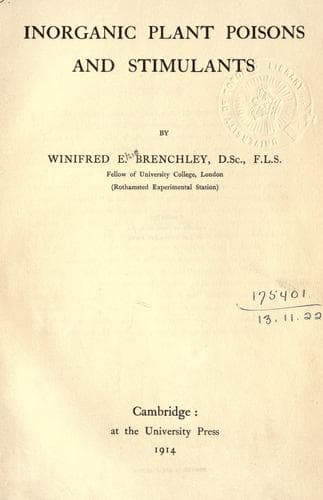
Inorganic Plant Poisons and StimulantsBrenchley, Winifred Elsie
Science
Inorganic Plant Poisons and Stimulants
Brenchley, Winifred Elsie
Growth (Plants); Plants -- Effect of poisons on
Uchiyama (1907) carried on a variety of experiments with manganese
sulphate on several plants on different soils, both in the field and in
pots, and found that the compound exercised a favourable action in most
cases when applied in appropriate quantities. In summarising his results
he stated that both manganese and iron stimulate the development of
plants, different plants varying in their susceptibility to the action.
Sometimes a joint application of the two salts is the most beneficial,
sometimes an individual application is the better, in which case manganese
sulphate is generally better than ferric sulphate in its action. The
stimulating action of manganese varies greatly with the character of the
soil, and the mode of application also affects results. As a general rule
the manganese acts best when applied as a top dressing rather than when
added together with the manure. Further the stimulating action differs
greatly with the nature and reaction of the manurial mixture. Uchiyama
concludes that 20–50 kgm. per hectare of crystallised manganese sulphate
is a good general amount to apply.
Takeuchi (1909) corroborates the statements of the various writers that
plants differ in their response to the manganese manuring. Pot cultures,
in each of which 8 kgm. soil were similarly manured, received ·2 gm.
MnSO₄.4H₂O applied as a solution of 1/100 strength, the controls receiving
the same amount of water. The manganese increased the green weight of
spinach by 41%, while the dry weight of barley, peas and flax rose 5·3%,
19·4%, and 13·9% respectively above that of the untreated. The control
plants of flax were behind the manganese plants in growth and flowering,
while barley was the least stimulated of all the test-plants. Other
observations seemed to show that Leguminosae and Cruciferae are more
susceptible to manganese stimulation than are the Gramineae.
III. EFFECT OF MANGANESE COMPOUNDS ON CERTAIN OF THE LOWER PLANTS.
The information on this point is exceedingly meagre, possibly because of
the diversion of general attention to the higher plants in view of the
commercial interests involved.
Richards (1897) carried out experiments with various nutritive media
with the addition of certain metallic salts, including those of zinc,
iron, aluminium and manganese. The fungi tested were _Aspergillus niger_,
_Penicillium glaucum_ and _Botrytis cinerea_. His general conclusion was
that fungi may be stimulated, though it must not be concluded without
further investigation that all fungi react in the same degree to the same
reagent, but this conclusion is traversed by Loew and Sawa (1902). These
writers state that fungi are _not_ stimulated by manganese, and take this
as a proof that the improvement in the growth of phanerogams, induced by
manganese compounds, is not due to direct stimulation of the protoplasmic
activity, but to some other more obscure cause.
IV. PHYSIOLOGICAL CONSIDERATIONS OF MANGANESE STIMULATION.
Public-domain text, read in full here on John Shaqi.
Reviews
Reviews
No reviews yet
Be the first to share your thoughts on this work.
Elsewhere in the archive
Join the Discussion
Join the discussion
Sign in to leave a comment or review.
Sign InorCreate an account