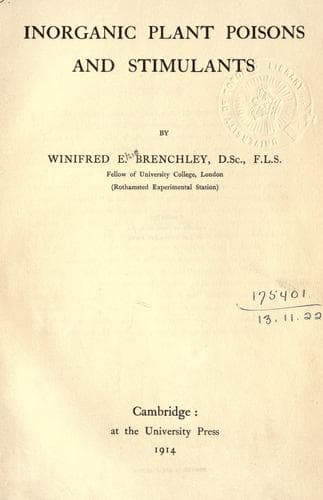
Inorganic Plant Poisons and StimulantsBrenchley, Winifred Elsie
Science
Inorganic Plant Poisons and Stimulants
Brenchley, Winifred Elsie
Growth (Plants); Plants -- Effect of poisons on
The physiological cause of the stimulation exerted by manganese compounds
has raised much controversy. Loew and Sawa suggested that the action of
the sun’s rays upon a normal plant puts a certain check on growth, arising
out of the action of certain noxious compounds which they supposed to be
produced in the cells under the influence of light. The stimulation of the
manganese compounds may be due to a supposed increase in the oxidising
powers of the oxidising enzymes, so that destruction of the checking
compounds can be accomplished as quickly as they are formed, so enabling
growth to continue more rapidly.
Asō (1902) had previously stated that colorimetric tests for oxidising
enzymes indicate that the yellowish leaves from plants treated with
manganese compounds give reactions of higher intensity than the green
leaves from control plants, the difference between the reactions being
specially marked in barley, and less so in radish.
Bertrand has devoted much time to the consideration of this and allied
problems. In 1897 (a, b, c) he proceeded to investigate the essential
nature of manganese in the economy of the plant, his experiments showing
its constant presence in a ferment (laccase) obtained from plants. He
also extracted from lucerne a substance very poor in manganese, which
was somewhat inactive, but which regained or increased its activity on
the addition of manganese. Bertrand stated that manganese was apparently
not to be replaced by another metal, not even by iron, and that the small
quantity of it occurring was no reason for regarding it as a _secondary_
element in the composition of plants. The view was also put forward that
in the presence of certain organic substances, such as hydroquinone,
pyrogallol or similar bodies, manganese is capable of fixing free oxygen
from the air, the volume of oxygen absorbed varying according to the
compound of manganese used. Bertrand was led to conceive the oxydases
as special combinations of manganese in which the acid radicle, probably
protein in nature and variable according to the ferment considered, would
have just the necessary affinity to maintain the metal in solution, i.e.
the form the most suitable for the part it has to play. The manganese
would then be, according to his view, the true active element of oxydase,
which functions as the “activator”; the albuminous matter, on the other
hand, gives to the ferment those special characters, which show themselves
in their behaviour with regard to reagents and physical agents. From this
point of view manganese could no longer be considered as a non-essential
element, but as a substance of vital necessity to the functions of
plant-life. The name “complementary” manure was suggested for compounds of
such elements as manganese, which exert a physiological action and which
were proposed for use as manures. Later (1905) Bertrand considered that
he had still further proved the indispensable nature of manganese. The
Public-domain text, read in full here on John Shaqi.
Reviews
Reviews
No reviews yet
Be the first to share your thoughts on this work.
Elsewhere in the archive
Join the Discussion
Join the discussion
Sign in to leave a comment or review.
Sign InorCreate an account