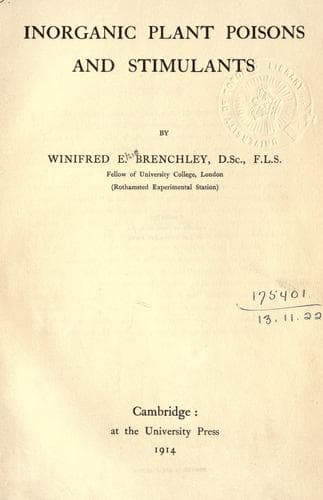
Inorganic Plant Poisons and StimulantsBrenchley, Winifred Elsie
Science
Inorganic Plant Poisons and Stimulants
Brenchley, Winifred Elsie
Growth (Plants); Plants -- Effect of poisons on
absence or insufficiency of one essential element arrests or diminishes
growth. This applies not only to those substances which are present in the
greatest abundance, such as C, P, N, &c., but also to those elements like
manganese, boron, and iodine, which only occur in traces. These elements
are usually specialised in function, and for them the name “catalytic”
elements was suggested, in view of the work they are held to do. As late
as 1910 the rôle of manganese in the functioning of the oxidising enzymes
was again insisted on. It was concluded that manganese intervenes as a
catalytic agent in the material changes of which plants are the seat,
and that it participates in an indirect manner in the building up of the
tissues and in the production of organic matter.
_Conclusion._
Manganese exerts a toxic influence upon the higher plants, if it is
presented in high concentration, but, in the absence of great excess
of the manganese compounds, the poisoning effect is overshadowed by a
definite stimulation. As is the case with boron, manganese stimulates some
species more than others, the action on barley being more evident than
that on peas. It seems probable that manganese may prove to be an element
essential to the economy of plant life, even though the quantity usually
found in plants is very small.
CHAPTER VIII
CONCLUSIONS
In the foregoing chapters a very limited number of plant poisons have been
considered, yet there is sufficient evidence to show that even these few
differ considerably in their action upon plant-life. This action is most
variable, and it is impossible to foretell the effect of any substance
upon vegetative growth without experiments. The degree of toxicity of the
different poisons is not the same, and also one and the same poison varies
in the intensity and nature of its action on different species of plants.
While certain compounds of copper, zinc and arsenic are exceedingly
poisonous, compounds of manganese and boron are far less deleterious,
so that a plant can withstand the presence of far more of the latter
substances than of the former. Again, the tested compounds of copper, zinc
and arsenic do not seem to stimulate growth, even when they are applied
in the smallest quantities, whereas very dilute solutions of manganese
and boron compounds decidedly increase growth. But, differentiation occurs
even in this stimulative action, for while manganese is the more effective
in stimulating barley, boric acid is far more potent for peas, the shoots
being particularly improved.
Public-domain text, read in full here on John Shaqi.
Reviews
Reviews
No reviews yet
Be the first to share your thoughts on this work.
Elsewhere in the archive
Join the Discussion
Join the discussion
Sign in to leave a comment or review.
Sign InorCreate an account