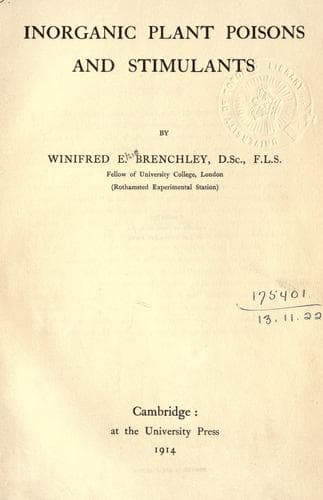
Inorganic Plant Poisons and StimulantsBrenchley, Winifred Elsie
Science
Inorganic Plant Poisons and Stimulants
Brenchley, Winifred Elsie
Growth (Plants); Plants -- Effect of poisons on
A consideration of the experimental work that has been done on this
subject of poisoning and stimulation leads one to the inevitable
conclusion that it is not true to maintain the hypothesis that _all_
inorganic plant poisons act as stimulants when they are present in very
small quantities, for while some poisons do increase plant growth under
such conditions, others fail to do so in any circumstances. It is probable
that what has been found true with the few substances tested would prove
to be similarly true over a much wider range of poisons, and at any rate
the hypothesis must be dismissed in its universal application. A more
accurate statement would be that some inorganic poisons act as stimulants
when present in small amounts, the stimulating concentrations varying both
with the poisons used and the plants on which they act.
It is quite possible for a stimulation in one respect to be correlated
with a retardation in another. In the Rothamsted experiments on the action
of manganese sulphate on barley the weaker concentrations of the salt
improved the vegetative growth, as was shown by the increase in the dry
weights, but with the same strengths of the poison the ripening of the
grain was retarded, so that, while certain of the physiological functions
were expedited, others were hindered by the action of the poison.
Thus it is evident that it is exceedingly difficult sharply to
characterise either toxic or stimulant action. In neither case is the
reaction simple--many factors may come into play and many processes are
concerned, while the effect of a so-called poison may vary in respect of
each of the functions and processes concerned. If the poison is presented
in great strength the toxic action is dominant, and probably affects
many functions in the same sense, so that the action is, so to speak,
cumulative. Lower down in the scale of concentration differentiation of
action may set in, and while some processes may still be hindered, others
may be stimulated. If the two actions balance one another an apparent
indifference may be manifested, so that it seems that such strengths of
the poison have no effect on growth, either harmful or beneficial. At
still lower concentrations, with certain plants and certain poisons, the
stimulative action overpowers the toxic effect, so that in some respect
or other improvement occurs in growth.
It is quite conceivable, however, that some poisons are truly indifferent
in weak concentrations, as no stimulation makes itself evident under any
circumstances. In these cases one is inclined to suspect that the action
is somewhat more simple, in that the toxic effects gradually diminish
until no poisonous action is manifest at very weak concentrations, and as
no stimulation is present to bring the growth above the normal with these
very weak concentrations the plant is similar to those grown without any
addition of the poison.
Public-domain text, read in full here on John Shaqi.
Reviews
Reviews
No reviews yet
Be the first to share your thoughts on this work.
Elsewhere in the archive
Join the Discussion
Join the discussion
Sign in to leave a comment or review.
Sign InorCreate an account