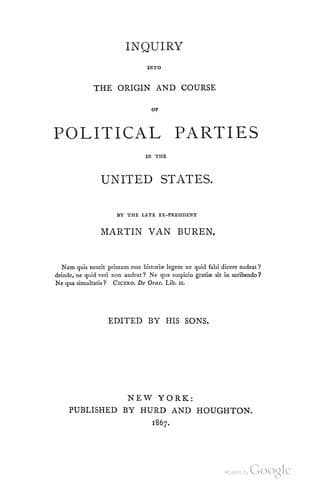
Inquiry Into the Origin and Course of Political Parties in the United StatesVan Buren, Martin
History
Inquiry Into the Origin and Course of Political Parties in the United States
Van Buren, Martin
Political parties -- United States
The terms "common defense and general welfare," used in this
enumeration, were taken from the Articles of Confederation, where they
stood thus: "All charges of war, and all other expenses that shall be
incurred for the _common defense and general welfare_, and allowed by
the United States, in Congress assembled, shall be defrayed out of a
common treasury, which shall be supplied by the several States in
proportion," &c. Under those Articles they were never understood as a
substantive grant of power to the Continental Congress, or as
authorizing that body to ask from the States moneys, and to expend them
for any purposes other than those which the Articles afterwards
specified. By the new Constitution the manner of getting the money was
happily changed from State requisitions to taxes, duties, imposts, and
excises, to be expended, however, when so obtained, for the common
defense and general welfare, as before, and the Constitution then, like
the Articles of Confederation, says upon what objects it is to be
expended. The Convention which framed and those which ratified the
instrument, of course, understood the terms as used in the same sense.
But after the Constitution was ratified, without an intimation of such
a construction having been whispered before, it was contended by many
that the manner in which the terms common defense and general welfare
were used in it authorized Congress to adopt _any measure_ which that
body might deem calculated to subserve the common defense and general
welfare of the country, whilst others, less reckless, limited the power
they claimed for Congress to the application of money to any such
measures. Among the former, as to the clause in the preamble, Hamilton
placed himself, insisting that, under the grant of powers to make all
laws which shall be necessary and proper for carrying its given powers
into execution, Congress had the power to adopt every measure of
government not expressly denied to it or exclusively granted to the
States, which it should deem useful in the execution of its enumerated
powers, however variant in its name, object, and general understanding;
and under the clause quoted from the preamble an unlimited power of
taxation, and an equally unlimited authority to expend the money so
raised upon objects which it might think would promote the common
defense and general welfare. He thus claimed for Congress substantially
all legislative power, save such as was expressly prohibited to it,
given exclusively to the States, or denied to both, falling but little
if any thing short of the power he assigned to the national legislature
in his propositions submitted to the Convention, which that body would
not even consider, viz.: "to pass all laws which they shall judge
necessary to the common defense and general welfare of the Union."
Public-domain text, read in full here on John Shaqi.
Reviews
Reviews
No reviews yet
Be the first to share your thoughts on this work.
Elsewhere in the archive
Join the Discussion
Join the discussion
Sign in to leave a comment or review.
Sign InorCreate an account