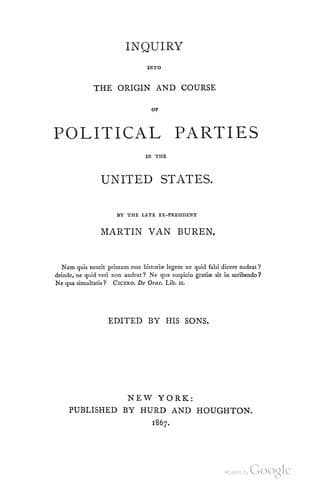
Inquiry Into the Origin and Course of Political Parties in the United StatesVan Buren, Martin
History
Inquiry Into the Origin and Course of Political Parties in the United States
Van Buren, Martin
Political parties -- United States
When the advocates of these doctrines were asked to remember the state
of public opinion at the time when the Constitution was framed; the
jealousy which then existed and had for so many years existed, of the
power of the General Government; the fact that the apprehensions which
had been entertained had so long prevented the calling of a Convention;
the extreme improbability that the Convention, under such circumstances,
could have intended to give to Congress the power to pass any law it
might be pleased to regard as useful in the execution of an enumerated
power, whatever might be its bearing upon the State governments; to add
to the power to make peace and war and to raise armies and equip fleets;
to make the power to raise money unlimited by authorizing its
expenditure upon any measure Congress might assume to be conducive to
the common defense and general welfare, and the absurdity of the
supposition that the grant of such far-reaching and absorbing powers
would have been conferred in so obscure a way, and that the Constitution
would have passed the scrutiny of so many State Conventions without its
ever having been intimated in any way that there lay concealed in its
general terms grants of power which, if but suspected, would have set
the country in a blaze, and would have produced instant refusals to
ratify on the part of most of the States,--when such considerations were
opposed to those bold pretensions, the only reply was, the Constitution
must be construed by its letter, and we cannot look behind it or beside
it for the means of doing so truly.
To the answer that extraneous matter has always been allowed by all
laws, state and national, to be used in the interpretation of the
highest acts of sovereignty, such as the construction of treaties
between sovereign powers, of patents issued under the great seal, of
acts of Parliament, of Congress, and of State legislatures, and in
respect to the latter class the old law, the mischief and the proposed
remedy to be taken into consideration in searching for the meaning of
such acts, in the construction of wills, deeds, &c., &c., the only
rejoinder was that a Constitution was an exception to those rules; in
short that a Constitution was the sole exception to the application of
the maxim which has grown out of the observation and experience of
mankind,--_qui hæret in literâ hæret in cortice_.
Public-domain text, read in full here on John Shaqi.
Reviews
Reviews
No reviews yet
Be the first to share your thoughts on this work.
Elsewhere in the archive
Join the Discussion
Join the discussion
Sign in to leave a comment or review.
Sign InorCreate an account