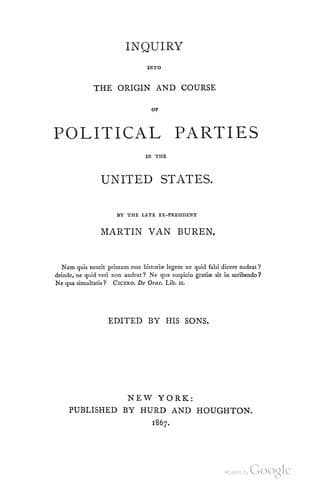
Inquiry Into the Origin and Course of Political Parties in the United StatesVan Buren, Martin
History
Inquiry Into the Origin and Course of Political Parties in the United States
Van Buren, Martin
Political parties -- United States
That a man trained in such a school, and who at the same time possessed
capacities to influence the public mind, when his efforts were properly
directed, far superior to any of his contemporaries, would, in the
condition in which he was placed, and under a government like our own,
take his political position on the popular side, was an anticipation
naturally entertained by the zealous friends of republican government.
But we have seen, on the contrary, that there was not, throughout the
wide extent of the Republic, a single man of respectable standing, more
deeply (and, let me add, more sincerely) distrustful of the judgment and
dispositions of the great body of the people, or more anxious to impose
restraints upon the popular will, and, for the accomplishment of that
object, to add to the intrinsic influence of associated wealth the
facilities for its exercise afforded by the possession of political
power. His case must not, however, be confounded with that of the
"candied tongues" found in every community which
"Lick absurd pomp,
And crook the pregnant hinges of the knee
That thrift may follow fawning."
Hamilton's mind was incapable of that condescension, or, as Mr.
Jefferson observed to me of him in connection with other matters, "he
was far above that." He participated largely as a professional man in
the favor and patronage of the commercial and manufacturing classes, but
instead of his own political course being influenced by the receipt of
such favors, he seldom failed to govern theirs. He was not a man to
mortgage his great abilities for personal benefits of any description,
and so well was his character in that respect understood that no one
would have ventured to tender him any inducement which might in the
estimation of the most prejudiced expose his personal independence to
the slightest question or suspicion. The fact, therefore, that he
pursued a course so different from what might have been naturally
expected of him by people generally--a course so much less eligible for
the gratification of ambitious views--affords high evidence of the
integrity of his motives. It proved that he acted under the influence of
opinions which had been honestly formed, and in the correctness of which
he confided to the end; opinions which he doubtless hoped would in the
sequel prove acceptable to the majority, but to which he felt it his
duty to adhere, whatever might be the consequences to himself of his
perseverance.
Public-domain text, read in full here on John Shaqi.
Reviews
Reviews
No reviews yet
Be the first to share your thoughts on this work.
Elsewhere in the archive
Join the Discussion
Join the discussion
Sign in to leave a comment or review.
Sign InorCreate an account