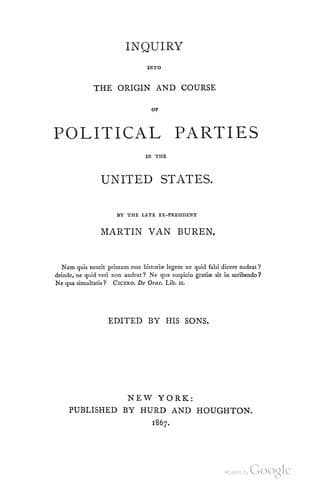
Inquiry Into the Origin and Course of Political Parties in the United StatesVan Buren, Martin
History
Inquiry Into the Origin and Course of Political Parties in the United States
Van Buren, Martin
Political parties -- United States
judicial power of the Government; were only authorized to act upon one
class of subjects--those which appertained to the judicial power of the
United States. The judges received their appointments from the same
source, and were responsible for their conduct to one head. Looking only
to judicial objects this might well be regarded as the judicial system
designed by the framers of the Constitution.
If ours had been a consolidated government these provisions would have
embraced the whole subject, and satisfied the wants of the whole
country. But in the actual state of things in that regard they were
inadequate to the accomplishment of that end. Instead of one
consolidated government ours was a confederacy of sovereign States,
presided over by a Federal Government which they had themselves created
and clothed with such powers as they deemed necessary to its efficiency
and usefulness, and as would be most likely to conduce to the freedom,
prosperity, and happiness of all.
With no other bond of union during the first years of the Revolutionary
contest than common danger, and obliged to struggle with a defective
Federal organization, these States succeeded in constructing for
themselves republican constitutions, and in several instances, before
the establishment of our Independence, sustained the brunt of that
struggle and came out of it with institutions fully adequate to all the
purposes of good government, including systems of jurisprudence and
competent tribunals for their administration. The administrators of
these institutions, driven to desperation by great public and private
distress,--the direct results of the oppression of the mother
country,--may in a few cases, and for a short period, have forgotten
that interests liable to sequestration in war were inviolable in peace,
and failed to interpose with sufficient alacrity a judicial barrier
against the attempts of some of the State legislatures to throw
obstructions in the way of the collection of British debts. But those
were limited and temporary aberrations, which would soon have yielded to
proper treatment on the part of the Federal Government. At the period of
the passage of the Judiciary Act the judges who presided in most of the
State courts might be compared without discredit to those who filled the
benches of the Federal courts, and this relative equality has ever since
been well maintained. Such has certainly been the case in the State of
New York. The name of Chancellor Livingston, who was then at the head of
our equity system, would lose nothing from a comparison with Chief
Justice Jay, when the latter was placed at the head of the Federal
courts. Our equity and common-law courts have since been graced by
Chancellor Lansing, Chief Justices Lewis and Kent, and Judges Brockholst
Livingston, Smith Thompson, Ambrose Spencer, Wm. W. Van Ness, and
others, all men of great talents and acquirements. Nor have the courts
of our sister States been wanting in this regard. The names of
Public-domain text, read in full here on John Shaqi.
Reviews
Reviews
No reviews yet
Be the first to share your thoughts on this work.
Elsewhere in the archive
Join the Discussion
Join the discussion
Sign in to leave a comment or review.
Sign InorCreate an account