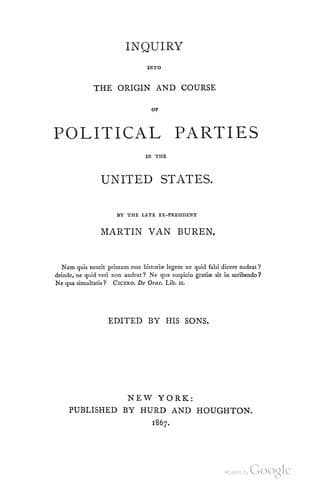
Inquiry Into the Origin and Course of Political Parties in the United StatesVan Buren, Martin
History
Inquiry Into the Origin and Course of Political Parties in the United States
Van Buren, Martin
Political parties -- United States
Some of the State societies rejected these modifications _in toto_, and
others only agreed to them partially. The agitation of the subject was
thus continued for several years, and as late as 1787 no State had yet
so far yielded its prejudices as to grant the charter for which the
constitution of the society made it the duty of the State meetings to
apply. Whatever opinion may at this day be formed in regard to the
sufficiency of the reasons for the alarm which this transaction
produced, it cannot be doubted that the proceedings in regard to it
afford strong proof that there was, down to the spring of 1787, a
settled aversion in the minds of a majority of the people to any measure
or course of measures which were indicative of the slightest desire to
return in any degree to the system which they had overthrown; and that
as early as 1783 strong suspicion existed that such desires were
concealed in the minds of many who had previously stood faithfully by
the country in all its perils.
The intense hostility of the colonists and their successors to
monarchical institutions, and the recollection of the cruelties
inflicted upon them and upon their predecessors under the authority of
kings, had produced a determined repugnance on their part to the
concentration of power in the hands of single magistrates. Their minds
had become thoroughly impressed with a conviction that the disposition
to abuse power by those who were intrusted with it was not only inherent
and invariable, but incurable, and that it was therefore unwise to grant
more than was actually indispensable to the management of public
affairs. At no period anterior to the adoption of the present
Constitution, could a majority be obtained in Congress for the creation
of an executive branch of the Government, or an impression be made upon
the public mind favorable to such a measure. The inconveniences
experienced from a want of it during a protracted war, and which were
again encountered in the public service after the recognition of our
independence, were not sufficient to overcome this repugnance. The
tenacity with which they adhered to an equal representation and
influence for the colonies before, and for the States after, the
Declaration of Independence, in the confederacies and governments they
formed, sprang from like considerations. They could not be brought to
believe that a State, to which was allowed a greater power than was
reserved to its confederates, could be restrained from the ultimate
exercise of her superior power to depress her smaller confederates and
to elevate herself.
Proofs of the existence and force of these opinions are spread through
every portion of our early history.
Public-domain text, read in full here on John Shaqi.
Reviews
Reviews
No reviews yet
Be the first to share your thoughts on this work.
Join the Discussion
Join the discussion
Sign in to leave a comment or review.
Sign InorCreate an account