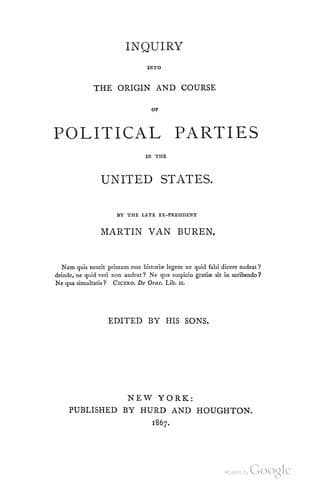
Inquiry Into the Origin and Course of Political Parties in the United StatesVan Buren, Martin
History
Inquiry Into the Origin and Course of Political Parties in the United States
Van Buren, Martin
Political parties -- United States
In 1643 the New England Colonies, with the exception of those "who ran a
different course" from the Puritans, entered into a Confederacy. Its
avowed design was the better advancement of their general interests, but
its real object was to provide greater security against the savages by
whom they were menaced. It was called the "United Colonies of New
England." The plan was for a season defeated, because Massachusetts
claimed more power than she was willing to concede to the other
colonies; but it was finally established upon principles of perfect
equality, no more power or influence being conceded to Massachusetts, by
far the largest, than to New Haven, the smallest colony. The management
of affairs was intrusted to commissioners, of which each colony had two,
but no executive power was conferred upon them. They might deliberate
and recommend, but the colonies alone could carry their recommendations
into effect. This Confederacy endured for nearly half a century, and
worked well.
In 1755 a convention of delegates from the colonies was held at Albany,
under the stimulus of French encroachments, and a plan of union, drawn
up by Dr. Franklin, was agreed upon and submitted to the colonies for
their approval. The plan, as was to be expected from the character of
its author, distributed the powers of the government between the people
and the prerogatives of the Crown, much more favorably to the popular
side than it would seem the latter might, in the then condition of
things, have reasonably hoped for. Still the attachments of the
colonists to their local governments, and, above all, their distrust and
dread of a central government, which was provided for, were sufficient
to deprive the plan of their favor, and to cause its ultimate
abandonment.
The privilege of "Government within themselves," as "their undoubted
right in the sight of God and man," and "to be governed by rulers of
their own choosing and laws of their own making," were from the
beginning objects of absorbing solicitude with the colonists and their
Revolutionary successors.
Public-domain text, read in full here on John Shaqi.
Reviews
Reviews
No reviews yet
Be the first to share your thoughts on this work.
Join the Discussion
Join the discussion
Sign in to leave a comment or review.
Sign InorCreate an account