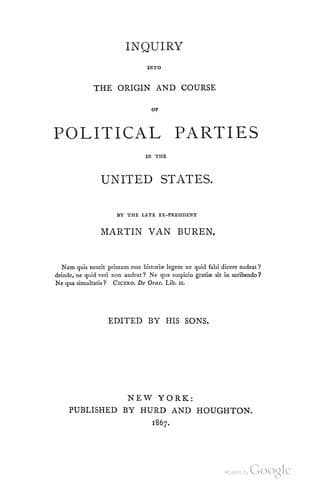
Inquiry Into the Origin and Course of Political Parties in the United StatesVan Buren, Martin
History
Inquiry Into the Origin and Course of Political Parties in the United States
Van Buren, Martin
Political parties -- United States
The principles and sentiments I have attempted to define, which had
sprung up at the earliest period in the colonies, and had grown with
their growth and strengthened with their strength, and in explanation of
which I have referred to a few of the many illustrations with which
their history abounds, were doubtless those also of a great majority of
the Whigs of the Revolution, in whose breasts was not wanting the
feeling which rarely fails to be seen in those political divisions that
lead to civil war,--a thorough antagonism to the general opinions, as
well as to the particular policy of the power or party opposed; but it
is equally true that those were far from being the principles or
feelings of all by whose efforts the Revolution was achieved. A numerous
portion of the Whigs of the Revolution, many of them greatly
distinguished for their talents, high characters, and great public
services, neither concurred in the principles nor sympathized with the
feelings I have described, but were in a great measure driven by other
considerations to take active parts in the struggle. The number thus
influenced was, fortunately for the result of the contest, increased by
specific tyrannical acts, which a prudent government would have avoided,
but which were forced on the ministry and Parliament of the mother
country by the obstinacy and bigotry of the king. Within a year after
his accession to the throne he wound up a series of unnecessary
interferences with the administration of justice in the colonies, by
changing the tenure of office, which had till that period prevailed in
relation to the colonial judges, from that of good behavior to that of
the will and pleasure of the Crown. By thus using his prerogative to
create a distinction in different parts of the realm degrading to the
colonies, he left the colonial lawyers no other course consistent with
self-respect, to say nothing of patriotism, than to unite with those
engaged in other pursuits in an effort to overthrow a government capable
of such practices. While subjecting the legal profession to such
humiliating proofs of the royal displeasure, his government commenced
its assaults upon that portion of his subjects engaged in commerce. His
indignation against those who scouted the doctrine of the British
Constitution, "that the king can do no wrong," was intense and
unappeasable in proportion to their presumed intelligence. It was in
this spirit that he appears to have selected judges, professional men,
and merchants, as special objects of his wrath, and having exerted his
power against the first two classes, he turned his attention toward the
latter.
Public-domain text, read in full here on John Shaqi.
Reviews
Reviews
No reviews yet
Be the first to share your thoughts on this work.
Join the Discussion
Join the discussion
Sign in to leave a comment or review.
Sign InorCreate an account