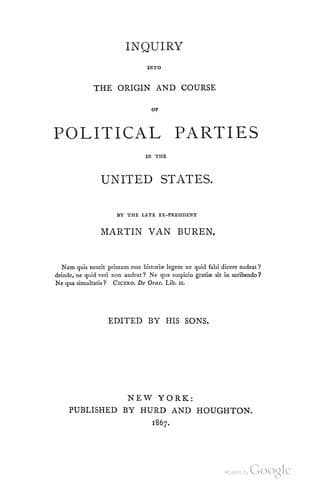
Inquiry Into the Origin and Course of Political Parties in the United StatesVan Buren, Martin
History
Inquiry Into the Origin and Course of Political Parties in the United States
Van Buren, Martin
Political parties -- United States
From the nature of
their action, members of Congress do not subject themselves to personal
responsibility, except when they act corruptly. But the situation of the
incumbent of the executive department is less favorable. Deprived of all
discretion, and bound to thus understand his position, he encounters
personal responsibility, in certain cases, whichever way he may act. If
he find a law upon the statute book, approved by one of his
predecessors--and to relieve the country from which has perhaps been one
of the reasons for the removal of the latter from office--a law which he
deems unauthorized by the Constitution, but which the Supreme Court
holds to be constitutional, he must either violate his oath of office
and execute it, or refuse to do so and expose himself to impeachment
for a failure in the discharge of his official duties. If he persists in
the observance of a law which the Supreme Court has, in a private suit,
held to be unconstitutional, he incurs a similar responsibility; and if
he omits its observance, he does violence to his own conscience by
failing to perform his official duties according to his oath. Let me
illustrate this view of the subject by particular and possible cases.
Take that referred to by General Hamilton in his papers written in
defense of President Washington's proclamation of neutrality, over the
signature of "Pacificus."
The President has power, by and with the advice of the Senate, to make
treaties with foreign governments. Private rights, subject to judicial
investigation, often grow out of public treaties. The interpretation and
enforcement of these rights belong exclusively to the judiciary, and in
the execution of its power it may hold the treaty, under which the claim
arises, unconstitutional for any of the reasons for which laws may be so
regarded. Its decision is binding and final upon the parties and their
interests.
Then comes the execution of that treaty between the governments that are
parties to it. This, on our part, belongs exclusively to the legislative
and executive departments. The duty of the former is to pass the laws
necessary to its execution, and that of the latter to see to their
enforcement, and to do such other acts as he may do, under the
Constitution, without a law.
Public-domain text, read in full here on John Shaqi.
Reviews
Reviews
No reviews yet
Be the first to share your thoughts on this work.
Elsewhere in the archive
Join the Discussion
Join the discussion
Sign in to leave a comment or review.
Sign InorCreate an account