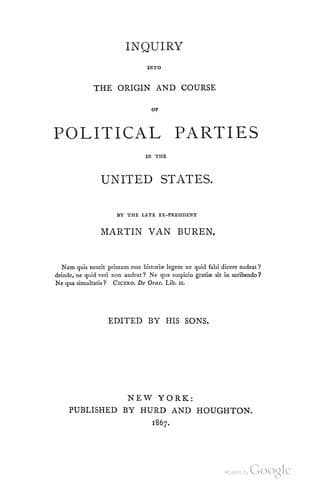
Inquiry Into the Origin and Course of Political Parties in the United StatesVan Buren, Martin
History
Inquiry Into the Origin and Course of Political Parties in the United States
Van Buren, Martin
Political parties -- United States
A foreign government calls for the interference of these departments to
redeem the national faith, pledged through executive instrumentality,
and for the redemption of which the executive, and the legislature,
where necessary, are the agents designated by the Constitution. They see
and feel their duty, but have been rendered powerless. The Supreme Court
has decided the treaty to be unconstitutional. No matter how obscure
the parties by whom its interference was asked, no matter how
unimportant the interest in respect to which the decision was made, from
the moment it is promulgated, it becomes a rule of action for every
department of the government, and every public functionary as well as
every citizen. If the national legislature passes a law to carry into
effect the void treaty its law becomes a nullity. If the executive
issues an order for its execution, or toward the performance of the
treaty in any way to his subordinates, they are not bound to obey it,
and the Supreme Court will sustain them in their contumacy. If he take
measures to enforce his authority, he makes himself amenable to that
tribunal. Acting in such a matter as a ministerial officer only, without
a right to employ his own discretion, he subjects himself to impeachment
if he persists.
Alexander Hamilton--who, if he was not the one who suggested the
latitudinarian doctrine of "implied powers," was certainly its most
effective supporter, and through life its watchful guardian--in No. 1 of
Pacificus, has said that though the judiciary department is charged with
the interpretation of treaties, "it exercises this function only where
contending parties bring before it a specific controversy;" that "it has
no concern with pronouncing upon the external political relation of
treaties between government and government;" that "this proposition is
too plain to need being insisted upon;" that "it belongs to the
executive department to exercise the function in question, when a proper
case for it occurs," "as the _interpreter_ of the national treaties, in
those cases in which the judiciary is not competent,--that is, between
government and government; as the _power_ which is charged with the
execution of the laws, of which treaties form a part; as that which is
charged with the command and disposition of the public force."
Public-domain text, read in full here on John Shaqi.
Reviews
Reviews
No reviews yet
Be the first to share your thoughts on this work.
Elsewhere in the archive
Join the Discussion
Join the discussion
Sign in to leave a comment or review.
Sign InorCreate an account