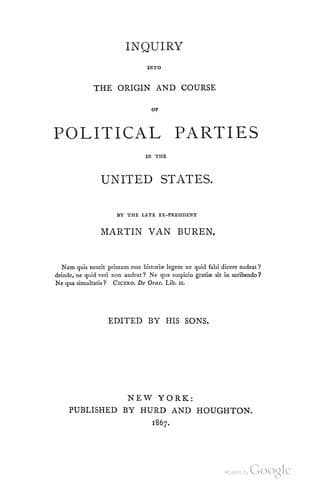
Inquiry Into the Origin and Course of Political Parties in the United States — John Shaqi
Inquiry Into the Origin and Course of Political Parties in the United StatesVan Buren, Martin
History
Inquiry Into the Origin and Course of Political Parties in the United States
Van Buren, Martin
Political parties -- United States
The so-called Government of the Confederation was little else than an
alliance between the States--a federal league and compact, the terms of
which were set forth in the Articles of Confederation. Besides a
control over questions of Peace and War, its powers and duties were
chiefly advisory, and dependent for their execution upon the coöperation
of the States. A federal system so defective was justly held responsible
for a large share of the public and private embarrassments that existed
at, or arose after, the termination of the Revolutionary contest. It was
also, as was natural, charged in some degree with those which were, in
truth, unavoidable consequences of a seven years' war, and which would
have existed under any system. It is not surprising, therefore, that a
party bent upon its overthrow should have arisen as soon as the public
mind was by the course of events brought to a proper state to consider
the subject. Of this party Alexander Hamilton became the leader, and its
immediate objects were, of course, very soon frankly developed. These
were in the first instance to divest the State governments of certain
powers, and to confer them upon Congress, the possession of which by the
Federal head they deemed indispensable to the exigencies of the public
service, with the intention of following up this step by an attempt to
abrogate the Articles of Confederation, and to substitute for that
system an independent and effective Federal Government, composed of
executive, legislative, and judicial departments. In respect to the
powers to be given to the new Government, and to its construction
otherwise, there doubtless existed some differences of opinion among the
members of this party; but all agreed that it should be what in the
language of the day was called a "strong government." There may not have
been entire harmony among them in regard to the expediency and
practicability of attempting it, but I do not think there is reasonable
ground to doubt that most of them desired a virtual consolidation of the
two systems--Federal and State. A few were, from an early period,
suspected by those who differed from them, and who became their
opponents, of desiring to return to the English system, and this
suspicion, doubtless, contributed to make the latter more impracticable
than they might otherwise have been.
Public-domain text, read in full here on John Shaqi.
Reviews
Reviews
No reviews yet
Be the first to share your thoughts on this work.
Join the Discussion
Join the discussion
Sign in to leave a comment or review.
Sign InorCreate an account