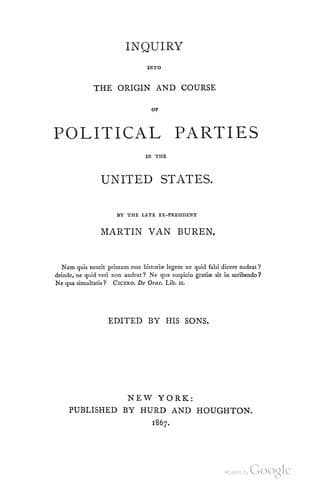
Inquiry Into the Origin and Course of Political Parties in the United StatesVan Buren, Martin
History
Inquiry Into the Origin and Course of Political Parties in the United States
Van Buren, Martin
Political parties -- United States
The political feelings which lay nearest to the hearts of the great body
of the people, as well during our colonial condition as in the States
after the declaration and establishment of Independence, and of the
strength of which I have referred to such striking and oft-repeated
illustrations, were those of veneration and affection for their local
governments as safeguards of their liberties and adequate to most of
their wants; endeared to them as their refuge from the persecutions of
arbitrary power, and hallowed by the perils and triumphs of the
Revolution. Allied to these feelings, and nearly co-extensive with them
in point of duration, was a distrust, at both periods, on the part of
the masses, of what they called an overshadowing general government.
When to these sources of opposition to the views of the party which had
arrayed itself against the government of the Confederation is added the
natural and deeply seated hostility of those who dissented from its
views in respect to hereditary government in any form, and the suspicion
of a reserved preference for such, or at least for kindred institutions,
we cannot be at a loss in accounting for the origin of the first two
great parties which sprang up and divided the country so soon after the
establishment of our Independence.
But the names by which these parties were distinguished are, it must be
admitted, not so intelligible. The name of Anti-Federalists was
strangely enough given by their opponents to those who advocated the
continuance of the Union upon the principles which prevailed in its
establishment, and according to which it was regarded as a Federal
League or Alliance of Free States, upon equal terms, founded upon a
compact (the Articles of Confederation) by which its conditions were
regulated,--to be represented by a general Congress, authorized to
consider and decide all questions appertaining to the interests of the
alliance and committed to its charge, without power either to act upon
the people directly or to apply force to the States, or otherwise to
compel a compliance with its decrees, and without any guarantee for
their execution other than the good faith of the parties to the compact.
On the other hand the name of Federalists was assumed, and, what is
still more extraordinary, retained by those who desired to reduce the
State governments, by the conjunction of which the Federal Union had
been formed, to the condition of corporations to be intrusted with the
performance of those offices only for the discharge of which a new
general government might think them the appropriate functionaries; to
convert the States, not perhaps in name, but practically and
substantially, into one consolidated body politic, and to establish over
it a government which should, at the least, be rendered independent and
effective by the possession of ample powers to devise, adopt, and
execute such measures as it might deem best adapted to common defense
and general welfare.
Public-domain text, read in full here on John Shaqi.
Reviews
Reviews
No reviews yet
Be the first to share your thoughts on this work.
Join the Discussion
Join the discussion
Sign in to leave a comment or review.
Sign InorCreate an account