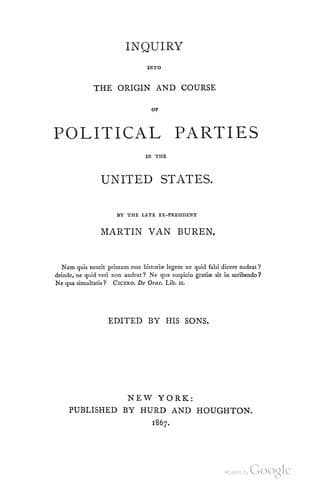
Inquiry Into the Origin and Course of Political Parties in the United StatesVan Buren, Martin
History
Inquiry Into the Origin and Course of Political Parties in the United States
Van Buren, Martin
Political parties -- United States
That this was a signal perversion of the true relation between party
names and party objects can scarcely be denied. Yet we who have, in
later days, witnessed the caprices in respect to party names to which
the public mind has been occasionally subjected, and the facility with
which one party has, through its superior address or its greater
activity, succeeded in attaching to its adversary an unsuitable and
unwelcome name, have not as much reason to be surprised at that
perversion as had the men of that day who were subjected to it.
The motive which operated in thus denying to men whose principles were
federal the name which indicated them, and in giving it to their
opponents, must be looked for in the fact that federal principles were
at that time favored by the mass of the people. This was well understood
at the time, and was made still more apparent by the circumstance that
those who really adhered to them, though compelled by the superior
address of their adversaries to act under the name of Anti-Federalists,
maintained their ascendancy in the government of the Confederation to
its close.
Those who require further proof of the truth of this position beyond
what results from a mere statement of the principles contended for by
the respective parties, will find it fully sustained by definitions of
Gouverneur Morris and James Madison. (2 Madison _Papers_, pp. 747-8, and
893.) Mr. Morris explained the distinction between a _federal_ and a
_national_ supreme government,--the former being a mere compact resting
on the good faith of the parties, the latter having a complete and
_compulsive_ operation. Mr. Madison, in the debate on the propositions
of Mr. Patterson, which constituted the plan of the Anti-Federalists,
and which were rejected by a vote of seven States to three,--one
(Maryland) divided,--said: "Much stress has been laid by some gentlemen
on the want of power in the Convention to propose any other than a
_federal_ plan.... Neither of the characteristics of a federal plan
would support this objection. One characteristic was that in a _federal_
government the power was exercised, not on the people _individually_,
but on the people _collectively_, on the _States_. The other
characteristic was that a _federal_ government derived its appointments,
not immediately from the people, but from the States which they
respectively composed."
It cannot be difficult to decide which of these parties was, in truth,
_federal_, and which _anti-federal_, according to these authentic
definitions of a federal government.[3]
Public-domain text, read in full here on John Shaqi.
Reviews
Reviews
No reviews yet
Be the first to share your thoughts on this work.
Join the Discussion
Join the discussion
Sign in to leave a comment or review.
Sign InorCreate an account