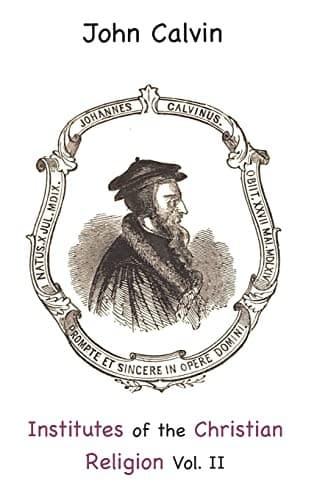
Institutes of the Christian Religion (Vol. 1 of 2) — John Shaqi
Institutes of the Christian Religion (Vol. 1 of 2)Calvin, Jean
ReligionChristian
Institutes of the Christian Religion (Vol. 1 of 2)
Calvin, Jean
Reformed Church -- Doctrines -- Early works to 1800; Theology, Doctrinal -- Early works to 1800
lying wonders.”(17) But these miracles (they say) are wrought, not by
idols, or sorcerers, or false prophets, but by saints; as if we were
ignorant, that it is a stratagem of Satan to “transform” himself “into an
angel of light.”(18) At the tomb of Jeremiah,(19) who was buried in Egypt,
the Egyptians formerly offered sacrifices and other divine honours. Was
not this abusing God’s holy prophet to the purposes of idolatry? Yet they
supposed this veneration of his sepulchre to be rewarded with a cure for
the bite of serpents. What shall we say, but that it has been, and ever
will be, the most righteous vengeance of God to “send those who receive
not the love of the truth strong delusions, that they should believe a
lie”?(20) We are by no means without miracles, and such as are certain,
and not liable to cavils. But those under which they shelter themselves
are mere illusions of Satan, seducing the people from the true worship of
God to vanity.
Another calumny is their charging us with opposition to the fathers,—I
mean the writers of the earlier and purer ages,—as if those writers were
abettors of their impiety; whereas, if the contest were to be terminated
by this authority, the victory in most parts of the controversy—to speak
in the most modest terms—would be on our side. But though the writings of
those fathers contain many wise and excellent things, yet in some respects
they have suffered the common fate of mankind; these very dutiful children
reverence only their errors and mistakes, but their excellences they
either overlook, or conceal, or corrupt; so that it may be truly said to
be their only study to collect dross from the midst of gold. Then they
overwhelm us with senseless clamours, as despisers and enemies of the
fathers. But we do not hold them in such contempt, but that, if it were
consistent with my present design, I could easily support by their
suffrages most of the sentiments that we now maintain. But while we make
use of their writings, we always remember that “all things are ours,” to
serve us, not to have dominion over us, and that “we are Christ’s”(21)
alone, and owe him universal obedience. He who neglects this distinction
will have nothing decided in religion; since those holy men were ignorant
of many things, frequently at variance with each other, and sometimes even
inconsistent with themselves. There is great reason, they say, for the
admonition of Solomon, “not to transgress or remove the ancient landmarks,
which our fathers have set.”(22) But the same rule is not applicable to
the bounding of fields, and to the obedience of faith, which ought to be
ready to “forget her own people and her father’s house.”(23) But if they
are so fond of allegorizing, why do they not explain the apostles, rather
than any others, to be those fathers, whose appointed landmarks it is so
unlawful to remove? For this is the interpretation of Jerome, whose works
they have received into their canons. But if they insist on preserving the
Public-domain text, read in full here on John Shaqi.
Reviews
Reviews
No reviews yet
Be the first to share your thoughts on this work.
Join the Discussion
Join the discussion
Sign in to leave a comment or review.
Sign InorCreate an account