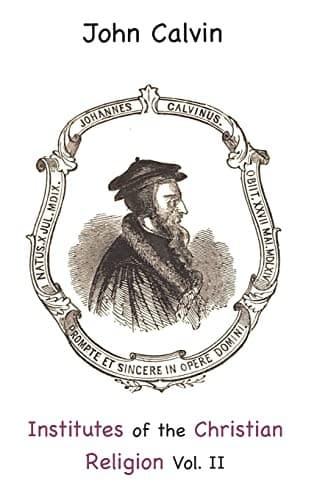
Institutes of the Christian Religion (Vol. 1 of 2) — John Shaqi
Institutes of the Christian Religion (Vol. 1 of 2)Calvin, Jean
ReligionChristian
Institutes of the Christian Religion (Vol. 1 of 2)
Calvin, Jean
Reformed Church -- Doctrines -- Early works to 1800; Theology, Doctrinal -- Early works to 1800
Bearing The Cross, Which Is A Branch Of Self‐Denial.
Chapter IX. Meditation On The Future Life.
Chapter X. The Right Use Of The Present Life And Its Supports.
Chapter XI. Justification By Faith. The Name And Thing Defined.
Chapter XII. A Consideration Of The Divine Tribunal, Necessary To A
Serious Conviction Of Gratuitous Justification.
Chapter XIII. Two Things Necessary To Be Observed In Gratuitous
Justification.
Footnotes
[Cover Art]
[Transcriber’s Note: The above cover image was produced by the submitter
at Distributed Proofreaders, and is being placed into the public domain.]
ADVERTISEMENT.
The Presbyterian Board of Publication, in introducing to the public a new
edition of the inimitable “Institutes of the Christian Religion,” do not
wish to be regarded as adopting all the sentiments and forms of expression
of the venerated writer; although they agree with him in his general
views, and admire the skill and learning with which he has pointed out the
relative positions and bearings of the great doctrines of revelation.
Calvin was better qualified than any of his contemporaries, to present
revealed truth in a connected and systematic form. His great natural
abilities, his profound erudition, his well balanced and discriminating
judgment, and his habits of diligent investigation, eminently fitted him
to prepare such a work as the “Institutes,” in which the doctrines of the
gospel are so clearly developed and harmonized, that the system has been
closely associated with his name, from the period of its publication until
the present time.
The honour of Calvin consisted, not in suggesting ingenious theories and
speculations, but in his general accuracy in interpreting the Holy
Scriptures, and in detecting and pointing out the connection of Scripture
doctrines, which, instead of being insulated, were shown to occupy their
respective places in forming a complete and perfect system of Divine
truth. The doctrines embraced in the formularies of the Presbyterian
Church are termed Calvinistic, from their general accordance with Calvin’s
interpretation of scriptural truth; but the admission of this term, as
explanatory of their general character, is not understood as by any means
implying an entire coincidence in the views of Calvin, or a submission to
his authority as an umpire in theological controversies. Although a
learned and pious, he was a fallible man; and his opinions, although
deserving of profound respect, are not to be blindly followed.
Public-domain text, read in full here on John Shaqi.
Reviews
Reviews
No reviews yet
Be the first to share your thoughts on this work.
Join the Discussion
Join the discussion
Sign in to leave a comment or review.
Sign InorCreate an account