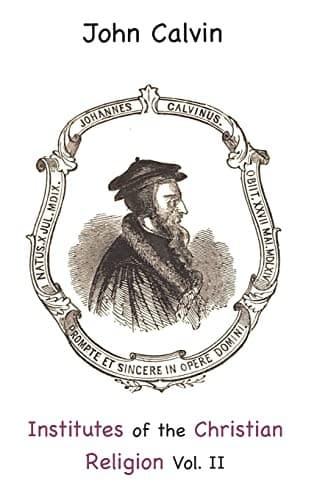
Institutes of the Christian Religion (Vol. 1 of 2)Calvin, Jean
ReligionChristian
Institutes of the Christian Religion (Vol. 1 of 2)
Calvin, Jean
Reformed Church -- Doctrines -- Early works to 1800; Theology, Doctrinal -- Early works to 1800
While admitting that the “Institutes,” considering the times and
circumstances in which they were written, form an invaluable body of
divinity, still it must be acknowledged, that some of the doctrines
therein maintained have been more luminously set forth in modern times. We
would especially mention as an instance the doctrine of justification
through the imputed righteousness of Christ. Some of the expressions of
Calvin on the subject of reprobation may be regarded as too unqualified,
and we can no further endorse them than as they are incorporated in the
Presbyterian Confession of Faith. The most decidedly objectionable feature
in the “Christian Institutes,” is to be found in the explanation of the
Fourth Commandment, where the author asserts the abrogation of the
Sabbath. In Calvin’s view, this ordinance was a mere type of better
blessings, and, with the types and ceremonies of the old dispensation, was
done away by the introduction of a new and better dispensation. In this
opinion there can be no doubt that he greatly erred; and so universal is
the conviction of the Church on the perpetual obligation of the Sabbath as
a moral institution, that no danger is to be apprehended from a contrary
view, even under the sanction of so great a name as that of Calvin. In
justice to his opinion on this subject, however, it should be stated, that
he distinctly recognized not only the propriety but the necessity of a
consecration of stated days for public religious services, without which
regulation, he declares that “it is so far from being possible to preserve
order and decorum, that if it were abolished, the Church would be in
imminent danger of immediate convulsion and ruin.” It is much to be
lamented that so great a mind should have been led astray on so important
a point by attempting to avoid an opposite extreme.
The Board of Publication have been induced to undertake this edition, by
the very generous offer of the First and Second Presbyterian Churches in
Baltimore, of which the Rev. John Backus and the Rev. Dr. R. J.
Breckinridge are respectively Pastors, to defray the expense of
stereotyping the work. Under the direction of the Executive Committee of
the Board, the translation has been diligently compared throughout with
the original Latin and French, and various corrections have been made to
convey the meaning of the author more distinctly and accurately. This
laborious duty has been performed by a member of the Publishing Committee.
The intrinsic excellence of the work, taken in connection with the
attractive style, and comparative cheapness, of the present edition,
induces the Committee to hope, that it may be widely circulated and
carefully studied, both by the clergy and laymen of the Presbyterian
Church.
In behalf of the Executive Committee,
William M. Engles, EDITOR.
THE TRANSLATOR’S PREFACE.
Public-domain text, read in full here on John Shaqi.
Reviews
Reviews
No reviews yet
Be the first to share your thoughts on this work.
Join the Discussion
Join the discussion
Sign in to leave a comment or review.
Sign InorCreate an account