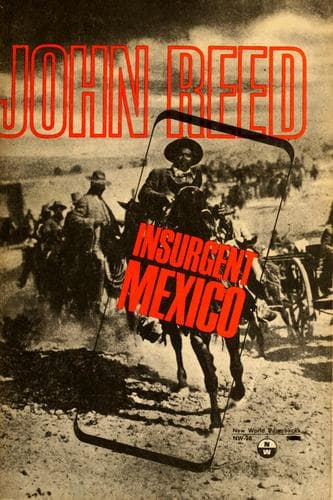
Mexico -- History -- 1910-1946; Mexico -- History -- Revolution, 1910-1920
I promised, and, together with another reporter, followed him across the
square to the beautiful little yellow municipal palace. We stood a
while in the patio. The place was thronged with self-important Mexicans
button-holing other self-important Mexicans who rushed from door to door
with portfolios and bundles of papers. Occasionally, when the door of
the Department of the Secretaryship opened, a roar of typewriters smote
our ears. Officers in uniform stood about the portico waiting for
orders. General Obregon, Commander of the Army of Sonora, was outlining
in a loud voice the plans for his march south upon Guadalajara. He
started for Hermosillo three days afterward, and marched his army four
hundred miles through a friendly country in three months. Although
Obregon had shown no startling capacity for leadership, Carranza had
made him General-in-Chief of the Army of the North-West, with a rank
equal to Villa’s. Talking to him was a stout, red-haired Mexican woman
in a black satin princess dress embroidered with jet, with a sword at
her side. She was Colonel Ramona Flores, Chief-of-Staff to the
Constitutionalist General Carrasco, who operates in Tepic. Her husband
had been killed while an officer in the first Revolution, leaving her a
gold-mine, with the proceeds of which she had raised a regiment and
taken the field. Against the wall lay two sacks of gold ingots which
she had brought north to purchase arms and uniforms for her troops.
Polite American concession-seekers shifted from one foot to the other,
hat in hand. The ever-present arms and ammunition drummers poured into
the ears of whoever would listen, praises of their guns and bullets.
Four armed sentries stood at the palace doors, and others lounged around
the patio. There were no more in sight, except two who flanked a little
door half-way down the corridor. These men seemed more intelligent than
the others. Anybody who passed was scrutinized carefully, and those who
paused at the door were questioned according to some thorough formula.
Every two hours this guard was changed; the relief was in charge of a
general, and a long colloquy took place before the change was effected.
"What room is that?" I asked Señor Fabela.
"That is the office of the First Chief of the Revolution," he answered.
I waited for perhaps an hour, and during that time I noticed that nobody
entered the room except Señor Fabela and those he took with him.
Finally he came over to me and said:
"All right. The First Chief will see you now."
We followed him. The soldiers on guard threw up their rifles.
"Who are these señores?" asked one.
"It’s all right. They are friends," answered Fabela, and opened the
door.
Public-domain text, read in full here on John Shaqi.
Reviews
Reviews
No reviews yet
Be the first to share your thoughts on this work.
Elsewhere in the archive
Join the Discussion
Join the discussion
Sign in to leave a comment or review.
Sign InorCreate an account