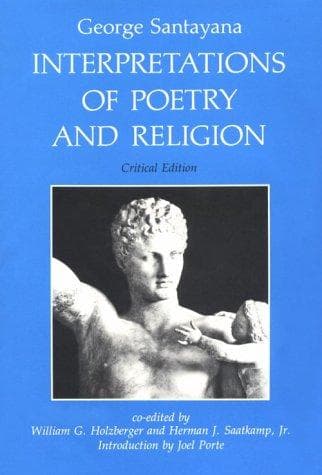
Interpretations of Poetry and ReligionSantayana, George
Religion
Interpretations of Poetry and Religion
Santayana, George
Aesthetics; Literature -- History and criticism; Poetry; Religion
In these latter times, with the prodigious growth of material life in
elaboration and of mental life in diffusion, there has supervened upon
this old dualism a new faith in man's absolute power, a kind of return
to the inexperience and self-assurance of youth. This new inspiration
has made many minds indifferent to the two traditional disciplines 5
neither is seriously accepted by them, for the reason, excellent from
their own point of view, that no discipline whatever is needed. The
memory of ancient disillusions has faded with time. Ignorance of the
past has bred contempt for the lessons which the past might teach. Men
prefer to repeat the old experiment without knowing that they repeat it.
I say advisedly ignorance of the past, in spite of the unprecedented
historical erudition of our time for life is an art not to be learned
by observation, and the most minute and comprehensive studies do not
teach us what the spirit of man should have learned by its long living.
We study the past as a dead object, as a ruin, not as an authority
and as an experiment. One reason why history was less interesting
to former ages was that they were less conscious of separation
from the past. The perspective of time was less clear because the
synthesis of experience was more complete. The mind does not easily
discriminate the successive phases of an action in which it is still
engaged; it does not arrange in a temporal series the elements of a
single perception, but posits them all together as constituting a
permanent and real object. Human nature and the life of the world
were real and stable objects to the apprehension of our fore-fathers
; the actors changed, but not the characters or the play. Men were
then less studious of derivations because they were more conscious of
identities. They thought of all reality as in a sense contemporary,
and in considering the maxims of a philosopher or the style of a poet,
they were not primarily concerned with settling his date and describing
his environment. The standard by which they judged was eternal; the
environment in which man found himself did not seem to them subject of
any essential change.
To us the picturesque element in history is more striking because we
feel ourselves the children of our own age only, an age which being
itself singular and revolutionary, tends to read its own character into
the past, and to regard all other periods as no less fragmentary and
effervescent than itself. The changing and the permanent elements are,
indeed, everywhere present, and the bias of the observer may emphasize
the one or the other as it will: the only question is whether we find
the significance of things in their variations or in their similarities.
Public-domain text, read in full here on John Shaqi.
Reviews
Reviews
No reviews yet
Be the first to share your thoughts on this work.
Elsewhere in the archive
Join the Discussion
Join the discussion
Sign in to leave a comment or review.
Sign InorCreate an account