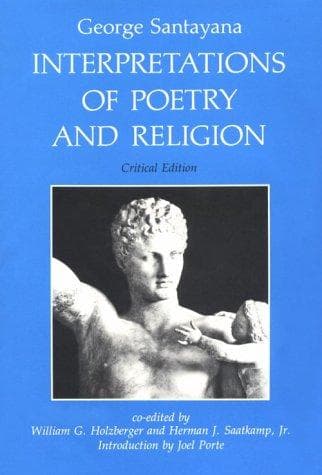
Interpretations of Poetry and ReligionSantayana, George
Religion
Interpretations of Poetry and Religion
Santayana, George
Aesthetics; Literature -- History and criticism; Poetry; Religion
In every imaginative sphere the nineteenth century has been an era
of chaos, as it has been an era of order and growing organization in
the spheres of science and of industry. An ancient doctrine of the
philosophers asserts that to chaos the world must ultimately return.
And what is perhaps true of the cycles of cosmic change is certainly
true of the revolutions of culture. Nothing lasts for ever: languages,
arts, and religions disintegrate with time. Yet the perfecting of such
forms is the only criterion of progress; the destruction of them the
chief evidence of decay. Perhaps fate intends that we should have, in
our imaginative decadence, the consolation of fancying that we are
still progressing, and that the disintegration of religion and the
arts is bringing us nearer to the protoplasm of sensation and passion.
If energy and actuality are all that we care for, chaos is as good as
order, and barbarism as good as discipline--better, perhaps, since
impulse is not then restrained within any bounds of reason or beauty.
But if the powers of the human mind are at any time adequate to the
task of digesting experience, clearness and order inevitably supervene.
The moulds of thought are imposed upon Nature, and the conviction of a
definite truth arises together with the vision of a supreme perfection.
It is only at such periods that the human animal vindicates his title
of rational. If such an epoch should return, people will no doubt
retrace our present gropings with interest and see in them gradual
approaches to their own achievement. Whitman and Browning might well
figure then as representatives of our time. For the merit of being
representative cannot be denied them. The mind of our age, like theirs,
is choked with materials, emotional, and inconclusive. They merely
aggravate our characteristics, and their success with us is due partly
to their own absolute strength and partly to our common weakness. If
once, however, this imaginative weakness could be overcome, and a form
found for the crude matter of experience, men might look back from the
height of a new religion and a new poetry upon the present troubles of
the spirit; and perhaps even these things might then be pleasant to
remember.
VIII
EMERSON
Public-domain text, read in full here on John Shaqi.
Reviews
Reviews
No reviews yet
Be the first to share your thoughts on this work.
Elsewhere in the archive
Join the Discussion
Join the discussion
Sign in to leave a comment or review.
Sign InorCreate an account