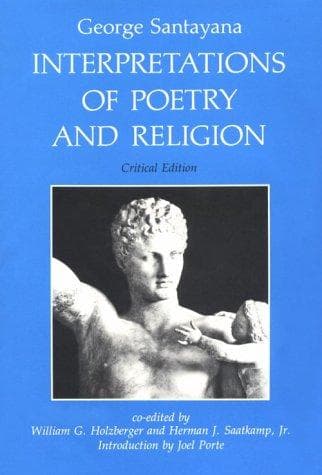
Interpretations of Poetry and ReligionSantayana, George
Religion
Interpretations of Poetry and Religion
Santayana, George
Aesthetics; Literature -- History and criticism; Poetry; Religion
Thus mysticism, although a principle of dissolution, carries with it
the safeguard that it can never be consistently applied. We reach it
only in exceptional moments of intuition, from which we descend to our
pots and pans with habits and instincts virtually unimpaired. Life goes
on; virtues and affections endure, none the worse, the mystic feels,
for that slight film of unreality which envelops them in a mind not
unacquainted with ecstasy. And although mysticism, left free to express
itself, can have no other goal than Nirvana, yet moderately indulged
in and duly inhibited by a residuum of conventional sanity, it serves
to give a touch of strangeness and elevation to the character and to
suggest superhuman gifts. It is not, however, in the least superhuman.
It is hardly even abnormal, being only an exaggeration of a rational
interest in the highest abstractions. The divine, the universal, the
absolute, even the One, are legitimate conceptions. They are terms
of human thought having as such a meaning in language and a place
in speculation. Those who live in the mind, whose passions are only
audible in the keen overtones of dialectic, are no doubt exalted and
privileged natures, choosing a better part which should not be taken
from them. So the poet and the mathematician have their spheres of
abstract and delicate labour, in which a liberal legislator would not
disturb them. Trouble only arises when the dialectician represents
his rational dreams as knowledge of existences, and the mystic his
excusable raptures as the only way of life. Poets and mathematicians do
not imagine that their pursuits raise them above human limitations and
are no part of human life, but rather its only goal and justification.
Such a pretension would be regarded as madness in the mathematician
or the poet; and is not the mystic as miserably a man? Is he not
embodying, at his best, the analytic power of a logician, or the
imagination of an enthusiast, and, at his worst, the lowest and most
obscure passions of human nature?
Public-domain text, read in full here on John Shaqi.
Reviews
Reviews
No reviews yet
Be the first to share your thoughts on this work.
Join the Discussion
Join the discussion
Sign in to leave a comment or review.
Sign InorCreate an account