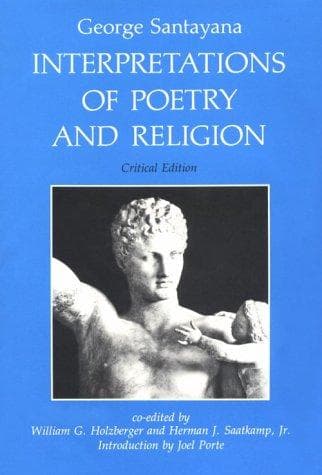
Interpretations of Poetry and Religion — John Shaqi
Interpretations of Poetry and ReligionSantayana, George
Religion
Interpretations of Poetry and Religion
Santayana, George
Aesthetics; Literature -- History and criticism; Poetry; Religion
Yes, in spite of himself, the mystic remains human. Nothing is
more normal than abstraction. A contemplative mind drops easily
its practical preoccupations, rises easily into an ideal sympathy
with impersonal things. The wheels of the universe have a wonderful
magnetism for the human will. Our consciousness likes to lose itself
in the music of the spheres, a music that finer ears are sometimes
privileged to catch. The better side of mysticism is an æsthetic
interest in large unities and cosmic laws. The æsthetic attitude is
not the moral, but it is not for that reason illegitimate. It gives us
refreshment and a foretaste of that perfect adaptation of things to
our faculties and of our faculties to things which, could it extend
to every part of experience, would constitute the ideal life. Such
happiness is denied us in the concrete; but a hint and example of it
may be gathered by an abstracted element of our nature as it travels
through an abstracted world. Such an indulgence adds to the value of
reality only such value as it may itself have in momentary experience;
it may have a doubtful moral effect on the happy dreamer himself. But
it serves to keep alive the conviction, which a confused experience
might obscure, that perfection is essentially possible; it reminds
us, like music, that there are worlds far removed from the actual
which are yet living and very near to the heart. Such is the fruit
of abstraction when abstraction bears any fruit. If the imagination
merely alienates us from reality, without giving us either a model for
its correction or a glimpse into its structure, it becomes the refuge
of poetical selfishness. Such selfishness is barren, and the fancy,
feeding only on itself, grows leaner every day. Mysticism is usually an
incurable disease. Facts cannot arouse it, since it never denied them.
Reason cannot convince it, for reason is a human faculty, assuming a
validity which it cannot prove. The only thing that can kill mysticism
is its own uninterrupted progress, by which it gradually devours every
function of the soul and at last, by destroying its own natural basis,
immolates itself to its inexorable ideal.
Need we ask, after all these reflections, where we should look for
that expansion and elevation of the mind which the mystic seeks so
passionately and so unintelligently? We can find that expansion, in
the first place, in the imagination itself. That is the true realm of
man's infinity, where novelty may exist without falsity and perpetual
diversity without contradiction. But such exercise of imagination
leaves the world of knowledge untouched. Is there no escape from the
prison, as the mystic thinks it, of science and history which shall
yet not carry us beyond reality? Is there no truth beyond conventional
truth, no life behind human existence?
Public-domain text, read in full here on John Shaqi.
Reviews
Reviews
No reviews yet
Be the first to share your thoughts on this work.
Join the Discussion
Join the discussion
Sign in to leave a comment or review.
Sign InorCreate an account