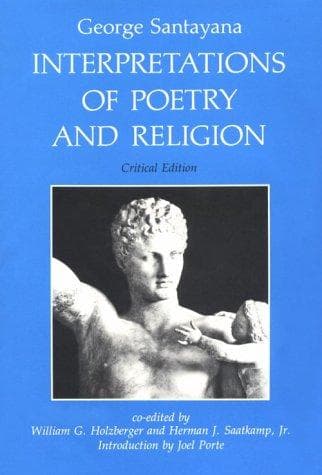
Interpretations of Poetry and ReligionSantayana, George
Religion
Interpretations of Poetry and Religion
Santayana, George
Aesthetics; Literature -- History and criticism; Poetry; Religion
Such a view has some relation to the real conditions of human life and
progress. What is called the higher optimism, on the contrary, commonly
consists in recounting all the evils of existence with a radiant
countenance, and telling us that they are all divine ministers of some
glorious consummation; but what this consummation is never appears, and
we are reduced in practice to a mere glorification of impulse. We are
simply invited to accept the conditions of life as they are, and to
find in incidental successes a compensation for incidental or--as we
should say if we were sincere--for essential failures. Such an optimism
impairs by a kind of philosophic Nature-worship that moral loyalty
which consists in giving the highest honour to the highest, not to the
strongest, things. It substitutes, as pantheism must, the study of
tendencies for the study of ends, and the dignity of success for the
dignity of justice.
This moral confusion our author avoids by his greater sincerity. He has
understood how fundamentally that man is a dupe who does not begin by
settling his accounts with Despair. There is no safety in lies; there
is no safety even in "postulates." Let the worst of the truth appear,
and when it has once seen the light, let it not be immediately wrapped
up again in the swaddling clothes of an equivocal rhetoric. In such a
disingenuous course there is both temerity and cowardice: temerity in
throwing away the opportunity, always afforded by the recognition of
fact, of cultivating the real faculties of human nature; cowardice in
not being willing to face with patience and dignity the situation in
which fate appears to have put us. That Nature is immense, that her
laws are mechanical, that the existence and well-being of man upon
earth are, from the point of view of the universe, an indifferent
incident,--all this is in the first place to be clearly recognized. It
is the lesson which both poetic contemplation and practical science had
taught Jean Lahor.
Public-domain text, read in full here on John Shaqi.
Reviews
Reviews
No reviews yet
Be the first to share your thoughts on this work.
Elsewhere in the archive
Join the Discussion
Join the discussion
Sign in to leave a comment or review.
Sign InorCreate an account