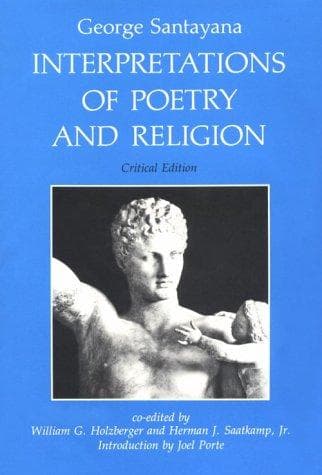
Interpretations of Poetry and ReligionSantayana, George
Religion
Interpretations of Poetry and Religion
Santayana, George
Aesthetics; Literature -- History and criticism; Poetry; Religion
If a critic, in despair of giving a serious definition of poetry,
should be satisfied with saying that poetry is metrical discourse,
he would no doubt be giving an inadequate account of the matter, yet
not one of which he need be ashamed or which he should regard as
superficial. Although a poem be not made by counting of syllables
upon the fingers, yet "numbers" is the most poetical synonym we have
for verse, and "measure" the most significant equivalent for beauty,
for goodness, and perhaps even for truth. Those early and profound
philosophers, the followers of Pythagoras, saw the essence of all
things in number, and it was by weight, measure, and number, as we read
in the Bible, that the Creator first brought Nature out of the void.
Every human architect must do likewise with his edifice; he must mould
his bricks or hew his stones into symmetrical solids and lay them over
one another in regular strata, like a poet's lines.
Measure is a condition of perfection, for perfection requires that
order should be pervasive, that not only the whole before us should
have a form, but that every part in turn should have a form of its
own, and that those parts should be coordinated among themselves as
the whole is coordinated with the other parts of some greater cosmos.
Leibnitz lighted in his speculations upon a conception of organic
nature which may be false as a fact, but which is excellent as an
ideal; he tells us that the difference between living and dead matter,
between animals and machines, is that the former are composed of parts
that are themselves organic, every portion of the body being itself
a machine, and every portion of that machine still a machine, and so
_ad infinitum_; whereas, in artificial bodies the organization is not
in this manner infinitely deep. Fine Art, in this as in all things,
imitates the method of Nature and makes its most beautiful works out of
materials that are themselves beautiful. So that even if the difference
between verse and prose consisted only in measure, that difference
would already be analogous to that between jewels and clay.
The stuff of language is words, and the sensuous material of words
is sound; if language therefore is to be made perfect, its materials
must be made beautiful by being themselves subjected to a measure,
and endowed with a form. It is true that language is a symbol for
intelligence rather than a stimulus to sense, and accordingly the
beauties of discourse which commonly attract attention are merely the
beauties of the objects and ideas signified; yet the symbols have a
sensible reality of their own, a euphony which appeals to our senses
if we keep them open. The tongue will choose those forms of utterance
which have a natural grace as mere sound and sensation; the memory will
retain these catches, and they will pass and repass through the mind
until they become types of instinctive speech and standards of pleasing
expression.
Public-domain text, read in full here on John Shaqi.
Reviews
Reviews
No reviews yet
Be the first to share your thoughts on this work.
Elsewhere in the archive
Join the Discussion
Join the discussion
Sign in to leave a comment or review.
Sign InorCreate an account