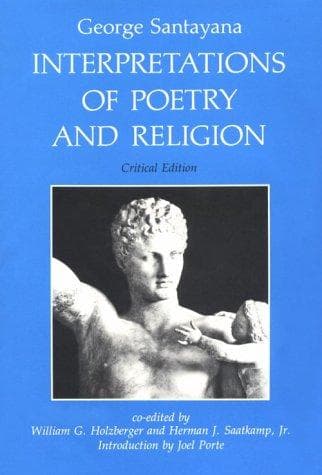
Interpretations of Poetry and ReligionSantayana, George
Religion
Interpretations of Poetry and Religion
Santayana, George
Aesthetics; Literature -- History and criticism; Poetry; Religion
The highest form of such euphony is song; the singing voice gives
to the sounds it utters the thrill of tonality,--a thrill itself
dependent, as we know, on the numerical proportions of the vibrations
that it includes. But this kind of euphony and sensuous beauty, the
deepest that sounds can have, we have almost wholly surrendered in our
speech. Our intelligence has become complex, and language, to express
our thoughts, must commonly be more rapid, copious, and abstract than
is compatible with singing. Music at the same time has become complex
also, and when united with words, at one time disfigures them in the
elaboration of its melody, and at another overpowers them in the volume
of its sound. So that the art of singing is now in the same plight as
that of sculpture,--an abstract and conventional thing surviving by
force of tradition and of an innate but now impotent impulse, which
under simpler conditions would work itself out into the proper forms of
those arts. The truest kind of euphony is thus denied to our poetry. If
any verses are still set to music, they are commonly the worst only,
chosen for the purpose by musicians of specialized sensibility and
inferior intelligence, who seem to be attracted only by tawdry effects
of rhetoric and sentiment.
When song is given up, there still remains in speech a certain sensuous
quality, due to the nature and order of the vowels and consonants
that compose the sounds. This kind of euphony is not neglected by the
more dulcet poets, and is now so studied in some quarters that I have
heard it maintained by a critic of relative authority that the beauty
of poetry consists entirely in the frequent utterance of the sound
of "j" and "sh," and the consequent copious flow of saliva in the
mouth. But even if saliva is not the whole essence of poetry, there
is an unmistakable and fundamental diversity of effect in the various
vocalization of different poets, which becomes all the more evident
when we compare those who use different languages. One man's speech, or
one nation's, is compact, crowded with consonants, rugged, broken with
emphatic beats; another man's, or nation's, is open, tripping, rapid,
and even. So Byron, mingling in his boyish fashion burlesque with
exquisite sentiment, contrasts English with Italian speech:--
"I love the language, that soft bastard Latin
Which melts like kisses from a female mouth
And sounds as if it should be writ on satin
With syllables which breathe of the sweet South,
And gentle liquids gliding all so pat in
That not a single accent seems uncouth,
Like our harsh Northern whistling, granting guttural
Which we're obliged to hiss and spit and sputter all."
Public-domain text, read in full here on John Shaqi.
Reviews
Reviews
No reviews yet
Be the first to share your thoughts on this work.
Elsewhere in the archive
Join the Discussion
Join the discussion
Sign in to leave a comment or review.
Sign InorCreate an account