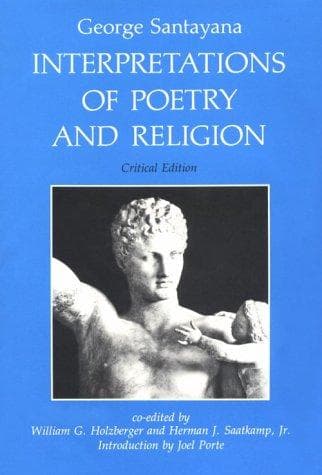
Interpretations of Poetry and ReligionSantayana, George
Religion
Interpretations of Poetry and Religion
Santayana, George
Aesthetics; Literature -- History and criticism; Poetry; Religion
And yet these contrasts, strong when we compare extreme cases, fade
from our consciousness in the actual use of a mother-tongue. The
function makes us unconscious of the instrument, all the more as it
is an indispensable and almost invariable one. The sense of euphony
accordingly attaches itself rather to another and more variable
quality; the tune, or measure, or rhythm of speech. The elementary
sounds are prescribed by the language we use, and the selection we
may make among those sounds is limited; but the arrangement of words
is still undetermined, and by casting our speech into the moulds of
metre and rhyme we can give it a heightened power, apart from its
significance. A tolerable definition of poetry, on its formal side,
might be found in this: that poetry is speech in which the instrument
counts as well as the meaning--poetry is speech for its own sake and
for its own sweetness. As common windows are intended only to admit
the light, but painted windows also to dye it, and to be an object
of attention in themselves as well as a cause of visibility in other
things, so, while the purest prose is a mere vehicle of thought, verse,
like stained glass, arrests attention in its own intricacies, confuses
it in its own glories, and is even at times allowed to darken and
puzzle in the hope of casting over us a supernatural spell.
Long passages in Shelley's "Revolt of Islam" and Keats' "Endymion"
are poetical in this sense; the reader gathers, probably, no definite
meaning, but is conscious of a poetic medium, of speech euphonious
and measured, and redolent of a kind of objectless passion which is
little more than the sensation of the movement and sensuous richness
of the lines. Such poetry is not great; it has, in fact, a tedious
vacuity, and is unworthy of a mature mind; but it is poetical, and
could be produced only by a legitimate child of the Muse. It belongs to
an apprenticeship, but in this case the apprenticeship of genius. It
bears that relation to great poems which scales and aimless warblings
bear to great singing--they test the essential endowment and fineness
of the organ which is to be employed in the art. Without this sensuous
background and ingrained predisposition to beauty, no art can reach the
deepest and most exquisite effects; and even without an intelligible
superstructure these sensuous qualities suffice to give that thrill of
exaltation, that suggestion of an ideal world, which we feel in the
presence of any true beauty.
Public-domain text, read in full here on John Shaqi.
Reviews
Reviews
No reviews yet
Be the first to share your thoughts on this work.
Elsewhere in the archive
Join the Discussion
Join the discussion
Sign in to leave a comment or review.
Sign InorCreate an account