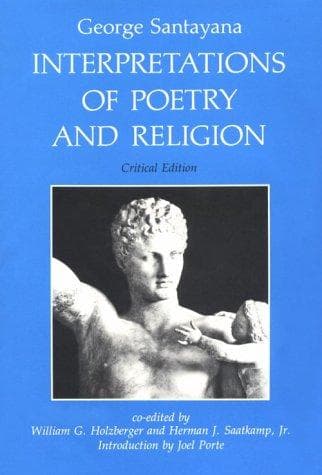
Interpretations of Poetry and ReligionSantayana, George
Religion
Interpretations of Poetry and Religion
Santayana, George
Aesthetics; Literature -- History and criticism; Poetry; Religion
Certainly. Behind the discovered there is the discoverable, beyond
the actual, the possible. Science and history are not exhausted. In
their determinate directions they are as infinite as fancy in its
indetermination. The spectacle which science and history now spread
before us is as far beyond the experience of an ephemeral insect as any
Absolute can be beyond our own; yet we have put that spectacle together
out of just such sensations as the insect may have--out of this
sunlight and this buzz and these momentary throbs of existence. The
understanding has indeed supervened, but it has supervened not to deny
the validity of those sensations, but to combine their messages. We may
still continue in the same path, by the indefinite extension of science
over a world of experience and of intelligible truth. Is that prospect
insufficient for our ambition? With a world so full of stuff before
him, I can hardly conceive what morbid instinct can tempt a man to look
elsewhere for wider vistas, unless it be unwillingness to endure the
sadness and the discipline of the truth.
But can our situation be made better by refusing to understand it? If
we renounced mysticism altogether and kept imagination in its place,
should we not live in a clearer and safer world, as well as in a
truer? Nay, are we sure that this gradually unfolding, intelligible,
and real world would not turn out to be more congenial and beautiful
than any wilful fiction, since it would be the product of a universal
human labour and the scene of the accumulated sufferings and triumphs
of mankind? When we compare the temple which we call Nature, built of
sights and sounds by memory and understanding, with all the wonderful
worlds evocable by the magician's wand, may we not prefer the humbler
and more lasting edifice, not only as a dwelling, but even as a house
of prayer? It is not always the loftiest architecture that expresses
the deepest soul; the inmost religion of the Pagan haunted his
hearth as that of the Christian his catacombs or his hermitage. So
philosophy is more spiritual in her humility and abstinence than in
her short-lived audacities, and she would do well to inscribe over her
gates what, in an ancient Spanish church, may be seen written near the
steep entrance to a little subterraneous crypt:--
"Wouldst thou pass this lowly door?
Go, and angels greet thee there;
For by this their sacred stair
To descend is still to soar.
Bid a measured silence keep
What thy thoughts be telling o'er;
Sink, to rise with wider sweep
To the heaven of thy rest,
For he climbs the heavens best
Who would touch the deepest deep."
II
THE HOMERIC HYMNS
Public-domain text, read in full here on John Shaqi.
Reviews
Reviews
No reviews yet
Be the first to share your thoughts on this work.
Join the Discussion
Join the discussion
Sign in to leave a comment or review.
Sign InorCreate an account