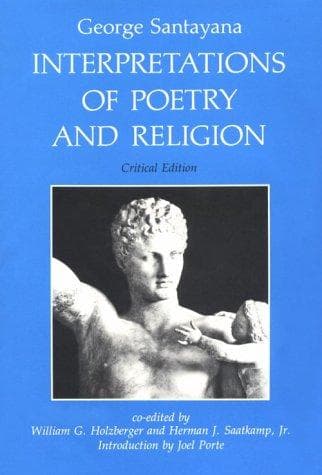
Interpretations of Poetry and ReligionSantayana, George
Religion
Interpretations of Poetry and Religion
Santayana, George
Aesthetics; Literature -- History and criticism; Poetry; Religion
The pathetic fallacy is a return to that early habit of thought by
which our ancestors peopled the world with benevolent and malevolent
spirits; what they felt in the presence of objects they took to be a
part of the objects themselves. In returning to this natural confusion,
poetry does us a service in that she recalls and consecrates those
phases of our experience which, as useless to the understanding of
material reality, we are in danger of forgetting altogether. Therein
is her vitality, for she pierces to the quick and shakes us out of our
servile speech and imaginative poverty; she reminds us of all we have
felt, she invites us even to dream a little, to nurse the wonderful
spontaneous creations which at every waking moment we are snuffing out
in our brain. And the indulgence is no mere momentary pleasure; much
of its exuberance clings afterward to our ideas; we see the more and
feel the more for that exercise; we are capable of finding greater
entertainment in the common aspects of Nature and life. When the veil
of convention is once removed from our eyes by the poet, we are better
able to dominate any particular experience and, as it were, to change
its scale, now losing ourselves in its infinitesimal texture, now in
its infinite ramifications.
If the function of poetry, however, did not go beyond this recovery
of sensuous and imaginative freedom, at the expense of disrupting our
useful habits of thought, we might be grateful to it for occasionally
relieving our numbness, but we should have to admit that it was nothing
but a relaxation; that spiritual discipline was not to be gained from
it in any degree, but must be sought wholly in that intellectual
system that builds the science of Nature with the categories of prose.
So conceived, poetry would deserve the judgment passed by Plato on
all the arts of flattery and entertainment; it might be crowned as
delightful, but must be either banished altogether as meretricious
or at least confined to a few forms and occasions where it might do
little harm. The judgment of Plato has been generally condemned by
philosophers, although it is eminently rational, and justified by the
simplest principles of morals. It has been adopted instead, although
unwittingly, by the practical and secular part of mankind, who look
upon artists and poets as inefficient and brain-sick people under whose
spell it would be a serious calamity to fall, although they may be
called in on feast days as an ornament and luxury together with the
cooks, hairdressers, and florists.
Public-domain text, read in full here on John Shaqi.
Reviews
Reviews
No reviews yet
Be the first to share your thoughts on this work.
Elsewhere in the archive
Join the Discussion
Join the discussion
Sign in to leave a comment or review.
Sign InorCreate an account