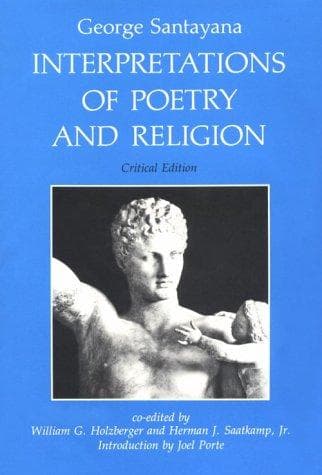
Interpretations of Poetry and ReligionSantayana, George
Religion
Interpretations of Poetry and Religion
Santayana, George
Aesthetics; Literature -- History and criticism; Poetry; Religion
Several circumstances, however, might suggest to us the possibility
that the greatest function of poetry may be still to find. Plato,
while condemning Homer, was a kind of poet himself; his quarrel with
the followers of the Muse was not a quarrel with the goddess; and
the good people of Philistia, distrustful as they may be of profane
art, pay undoubting honour to religion, which is a kind of poetry
as much removed from their sphere as the midnight revels upon Mount
Citheron, which, to be sure, were also religious in their inspiration.
Why, we may ask, these apparent inconsistencies? Why do our practical
men make room for religion in the background of their world? Why did
Plato, after banishing the poets, poetize the universe in his prose?
Because the abstraction by which the world of science and of practice
is drawn out of our experience, is too violent to satisfy even the
thoughtless and vulgar; the ideality of the machine we call Nature,
the conventionality of the drama we call the world, are too glaring
not to be somehow perceived by all. Each must sometimes fall back upon
the soul; he must challenge this apparition with the thought of death;
he must ask himself for the mainspring and value of his life. He will
then remember his stifled loves; he will feel that only his illusions
have ever given him a sense of reality, only his passions the hope and
the vision of peace. He will read himself through and almost gather a
meaning from his experience; at least he will half believe that all
he has been dealing with was a dream and a symbol, and raise his eyes
toward the truth beyond.
This plastic moment of the mind, when we become aware of the
artificiality and inadequacy of what common sense perceives, is the
true moment of poetic opportunity,--an opportunity, we may hasten
to confess, which is generally missed. The strain of attention, the
concentration and focussing of thought on the unfamiliar immediacy
of things, usually brings about nothing but confusion. We are dazed,
we are filled with a sense of unutterable things, luminous yet
indistinguishable, many yet one. Instead of rising to imagination, we
sink into mysticism.
To accomplish a mystical disintegration is not the function of any art;
if any art seems to accomplish it, the effect is only incidental, being
involved, perhaps, in the process of constructing the proper object of
that art, as we might cut down trees and dig them up by the roots to
lay the foundations of a temple. For every art looks to the building
up of something. And just because the world built up by common sense
and natural science is an inadequate world (a skeleton which needs the
filling of sensation before it can live), therefore the moment when we
realize its inadequacy is the moment when the higher arts find their
opportunity. When the world is shattered to bits they can come and
"build it nearer to the heart's desire."
Public-domain text, read in full here on John Shaqi.
Reviews
Reviews
No reviews yet
Be the first to share your thoughts on this work.
Elsewhere in the archive
Join the Discussion
Join the discussion
Sign in to leave a comment or review.
Sign InorCreate an account