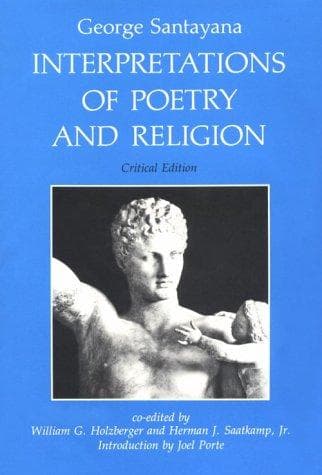
Interpretations of Poetry and ReligionSantayana, George
Religion
Interpretations of Poetry and Religion
Santayana, George
Aesthetics; Literature -- History and criticism; Poetry; Religion
Nevertheless, the function of poetry, like that of science, can only be
fulfilled by the conception of harmonies that become clearer as they
grow richer. As the chance note that comes to be supported by a melody
becomes in that melody determinate and necessary, and as the melody,
when woven into a harmony, is explicated in that harmony and fixed
beyond recall; so the single emotion, the fortuitous dream, launched
by the poet into the world of recognizable and immortal forms, looks
in that world for its ideal supports and affinities. It must find them
or else be blown back among the ghosts. The highest ideality is the
comprehension of the real. Poetry is not at its best when it depicts
a further possible experience, but when it initiates us, by feigning
something which as an experience is impossible, into the meaning of the
experience which we have actually had.
The highest example of this kind of poetry is religion; and although
disfigured and misunderstood by the simplicity of men who believe in
it without being capable of that imaginative interpretation of life
in which its truth consists, yet this religion is even then often
beneficent, because it colours life harmoniously with the ideal.
Religion may falsely represent the ideal as a reality, but we must
remember that the ideal, if not so represented, would be despised by
the majority of men, who cannot understand that the value of things
is moral, and who therefore attribute to what is moral a natural
existence, thinking thus to vindicate its importance and value. But
value lies in meaning, not in substance; in the ideal which things
approach, not in the energy which they embody.
The highest poetry, then, is not that of the versifiers, but that of
the prophets, or of such poets as interpret verbally the visions
which the prophets have rendered in action and sentiment rather than
in adequate words. That the intuitions of religion are poetical, and
that in such intuitions poetry has its ultimate function, are truths
of which both religion and poetry become more conscious the more they
advance in refinement and profundity. A crude and superficial theology
may confuse God with the thunder, the mountains, the heavenly bodies,
or the whole universe; but when we pass from these easy identifications
to a religion that has taken root in history and in the hearts of
men, and has come to flower, we find its objects and its dogmas
purely ideal, transparent expressions of moral experience and perfect
counterparts of human needs. The evidence of history or of the senses
is left far behind and never thought of; the evidence of the heart, the
value of the idea, are alone regarded.
Public-domain text, read in full here on John Shaqi.
Reviews
Reviews
No reviews yet
Be the first to share your thoughts on this work.
Elsewhere in the archive
Join the Discussion
Join the discussion
Sign in to leave a comment or review.
Sign InorCreate an account