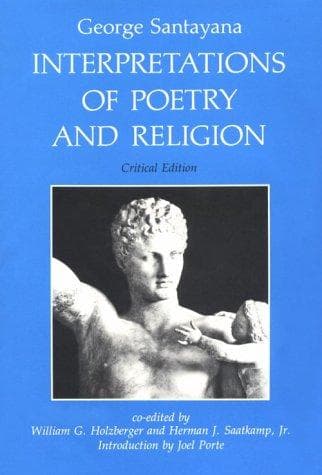
Interpretations of Poetry and ReligionSantayana, George
Religion
Interpretations of Poetry and Religion
Santayana, George
Aesthetics; Literature -- History and criticism; Poetry; Religion
Take, for instance, the doctrine of transubstantiation. A metaphor here
is the basis of a dogma, because the dogma rises to the same subtle
region as the metaphor, and gathers its sap from the same soil of
emotion. Religion has here rediscovered its affinity with poetry, and
in insisting on the truth of its mystery it unconsciously vindicates
the ideality of its truth. Under the accidents of bread and wine lies,
says the dogma, the substance of Christ's body, blood, and divinity.
What is that but to treat facts as an appearance, and their ideal
import as a reality? And to do this is the very essence of poetry, for
which everything visible is a sacrament--an outward sign of that inward
grace for which the soul is thirsting.
In this same manner, where poetry rises from its elementary and
detached expressions in rhythm, euphuism, characterization, and
story-telling, and comes to the consciousness of its highest function,
that of portraying the ideals of experience and destiny, then the
poet becomes aware that he is essentially a prophet, and either
devotes himself, like Homer or Dante, to the loving expression of
the religion that exists, or like Lucretius or Wordsworth, to the
heralding of one which he believes to be possible. Such poets are
aware of their highest mission; others, whatever the energy of their
genius, have not conceived their ultimate function as poets. They have
been willing to leave their world ugly as a whole, after stuffing it
with a sufficient profusion of beauties. Their contemporaries, their
fellow-countrymen for many generations, may not perceive this defect,
because they are naturally even less able than the poet himself to
understand the necessity of so large a harmony. If he is short-sighted,
they are blind, and his poetic world may seem to them sublime in its
significance, because it may suggest some partial lifting of their
daily burdens and some partial idealization of their incoherent
thoughts.
Public-domain text, read in full here on John Shaqi.
Reviews
Reviews
No reviews yet
Be the first to share your thoughts on this work.
Elsewhere in the archive
Join the Discussion
Join the discussion
Sign in to leave a comment or review.
Sign InorCreate an account