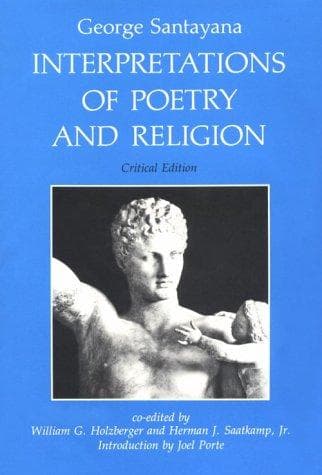
Interpretations of Poetry and ReligionSantayana, George
Religion
Interpretations of Poetry and Religion
Santayana, George
Aesthetics; Literature -- History and criticism; Poetry; Religion
Yet religion in all these cases differs from a mere play of the
imagination in one important respect; it reacts directly upon life;
it is a factor in conduct. Our religion is the poetry in which we
believe. Mere poetry is an ineffectual shadow of life; religion is,
if you will, a phantom also, but a phantom guide. While it tends to
its own expansion, like any growth in the imagination, it tends also
to its application in practice. Such an aim is foreign to poetry. The
inspirations of religion demand fidelity and courageous response on
our part. Faith brings us not only peace, not only the contemplation
of ideal harmonies, but labour and the sword. These two tendencies--to
imaginative growth and to practical embodiment--coexist in every
living religion, but they are not always equally conspicuous. In the
formative ages of Christianity, for instance, while its legends were
being gathered and its dogma fixed, the imaginative expansion absorbed
men's interest; later, when the luxuriant branches of the Church began
to shake off their foliage, and there came a time of year
"When yellow leaves, or none, or few, do hang
Upon those boughs which shake against the cold,"
the energy of religious thought, released from the enlargement of
doctrine, spent itself upon a more rigid and watchful application of
the residuum of faith.
In the Pagan religion the element of applicability might seem at first
sight to be lacking, so that nothing would subsist but a poetic fable.
An unbiassed study of antiquity, however, will soon dispel that idea.
Besides the gods whom we may plausibly regard as impersonations of
natural forces, there existed others; the spirits of ancestors, the
gods of the hearth, and the ideal patrons of war and the arts. Even the
gods of Nature inspired reverence and secured a cultus only as they
influenced the well-being of man. The worship of them had a practical
import. The conception of their nature and presence became a sanction
and an inspiration in the conduct of life. When the figments of the
fancy are wholly divorced from reality they can have no clearness or
consistency; they can have no permanence when they are wholly devoid of
utility. The vividness and persistence of the figures of many of the
gods came from the fact that they were associated with institutions and
practices which controlled the conception of them and kept it young.
The fictions of a poet, whatever his genius, do not produce illusion
because they do not attach themselves to realities in the world of
action. They have character without power and names without local
habitations. The gods in the beginning had both. Their image, their
haunts, the reports of their apparitions and miracles, gave a nucleus
of empirical reality to the accretions of legend. The poet who came
to sing their praise, to enlarge upon their exploits, and to explain
their cultus, gave less to the gods in honour than he received from
them in inspiration.
Public-domain text, read in full here on John Shaqi.
Reviews
Reviews
No reviews yet
Be the first to share your thoughts on this work.
Join the Discussion
Join the discussion
Sign in to leave a comment or review.
Sign InorCreate an account