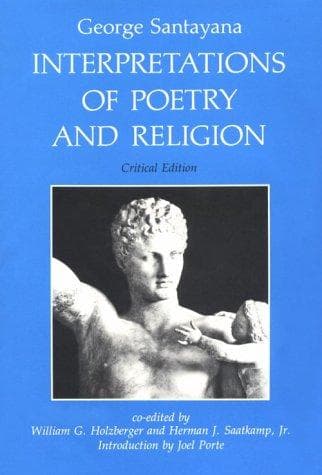
Interpretations of Poetry and Religion — John Shaqi
Interpretations of Poetry and ReligionSantayana, George
Religion
Interpretations of Poetry and Religion
Santayana, George
Aesthetics; Literature -- History and criticism; Poetry; Religion
"And for me, damsels, harbour pitiful
And favouring thoughts, dear children, that I come
To some good man's or woman's house, to ply
My task in willing service of such sort
As agèd women use. A tender child
I could nurse well and safely in my arms,
And tend the house, and spread the master's couch
Recessed in the fair chamber, or could teach
The maids their handicraft."
The offer is gladly accepted, for Celeus himself has an infant son,
Demophoon, the hope of his race: The aged woman enters the dwelling,
making in her long-robed grief a wonderful contrast to the four
sportive girls:--
"Who lifting up their ample kirtle-folds
Sped down the waggon-furrowed way, and shook
Their curls about their shoulders--yellow gold
Like crocuses in bloom."
Once within the house, which she awes with her uncomprehended presence,
the goddess sits absorbed in grief, until she is compelled to smile
for a moment at the jests of the quick-witted maid Iambe, and consents
to take in lieu of the wine that is offered her, a beverage of beaten
barley, water, and herbs. These details are of course introduced to
justify the ritual of Eleusis, in which the clown and the barley-water
played a traditional part.
Thus Demeter becomes nurse to Demophoon, but she has ideas of
her duties differing from the common, and worthy of her unusual
qualifications. She neither suckles nor feeds the infant but anoints
him with ambrosia and lays him at night to sleep on the embers of the
hearth. This his watchful mother discovers with not unnatural alarm;
when the goddess reveals herself and departs, foiled in her desire to
make her nursling immortal.
The spirit that animates this fable is not that poetic frivolity which
we are accustomed to associate with Paganism. Here we find an immortal
in profoundest grief and mortals entertaining an angel unawares; we are
told of supernatural food, and of a burning fire that might make this
mortal put on immortality did not the generous but ignorant impulses of
the natural man break in upon that providential purpose and prevent its
consummation. Eleusis was the natural home for such a myth, and we may
well believe that those initiated into the mysteries there were taught
to dwell on its higher interpretation.
But there are other hymns in a lighter vein in which the play of
fancy is not guided by any moral intuition. The hymn to Hermes is one
perpetual ebullition of irresponsible humour.
Public-domain text, read in full here on John Shaqi.
Reviews
Reviews
No reviews yet
Be the first to share your thoughts on this work.
Join the Discussion
Join the discussion
Sign in to leave a comment or review.
Sign InorCreate an account