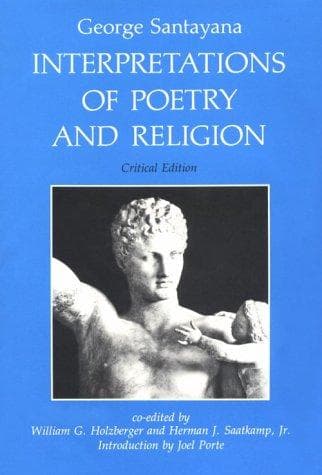
Interpretations of Poetry and ReligionSantayana, George
Religion
Interpretations of Poetry and Religion
Santayana, George
Aesthetics; Literature -- History and criticism; Poetry; Religion
Hermes is the child of Maia, a nymph of Cyllene whose cave Zeus has
surreptitiously visited while the white-armed Juno--for, unsympathetic
prude as this goddess may be, she must still be beautiful--slept
soundly in Olympus. The child is hardly born when he catches a
tortoise, kills it, scoops out the shell, and makes a lute of it, upon
which he begins to play delicious music. Not satisfied with that feat,
however, he escapes from his cradle, and drives from their pasture
the kine that Apollo has left feeding there. Accused afterward of this
mischief, he defends himself after the following fashion, while he lies
in his crib, holding his new-made lyre lightly in his hand under the
bedclothes. I quote Shelley's version:--
"'An ox-stealer should be both tall and strong
And I am but a little new-born thing
Who yet, at least, can think of nothing wrong.
My business is to suck, and sleep, and fling
The cradle-clothes about me all day long,
Or, half-asleep, hear my sweet mother sing
And to be washed in water clean and warm
And hushed and kissed and kept secure from harm.'"
* * * * * *
"Sudden he changed his plan, and with strange skill
Subdued the strong Latonian, by the might
Of winning music, to his mightier will.
His left hand held the lyre, and in his right
The plectrum struck the chords: unconquerable
Up from beneath his hand in circling flight
The gathering music rose--and sweet as Love
The penetrating notes did live and move
"Within the heart of great Apollo. He
Listened with all his soul, and laughed for pleasure.
Close to his side stood harping fearlessly
The unabashèd boy, and to the measure
Of the sweet lyre there followed loud and free
His joyous voice: for he unlocked the treasure
Of his deep song, illustrating the birth
Of the bright Gods, and the dark desert Earth;
"And how to the Immortals every one
A portion was assigned of all that is.
But chief Mnemosyne did Maia's son
Clothe in the light of his loud melodies.
And, as each god was born or had begun,
He in their order due and fit degrees
Sung of his birth and being--and did move
Apollo to unutterable love."
In fact, after the most enthusiastic encomiums on the young god's art,
and on the power of music in general, Apollo offers the child his
protection and friendship:--
"Now, since thou hast, although so very small,
Science of arts so glorious, thus I swear,--
And let this cornel javelin, keen and tall,
Witness between us what I promise here,--
That I will lead thee to the Olympian hall,
Honoured and mighty, with thy mother dear,
And many glorious gifts in joy will give thee
And even at the end will ne'er deceive thee."
Public-domain text, read in full here on John Shaqi.
Reviews
Reviews
No reviews yet
Be the first to share your thoughts on this work.
Join the Discussion
Join the discussion
Sign in to leave a comment or review.
Sign InorCreate an account