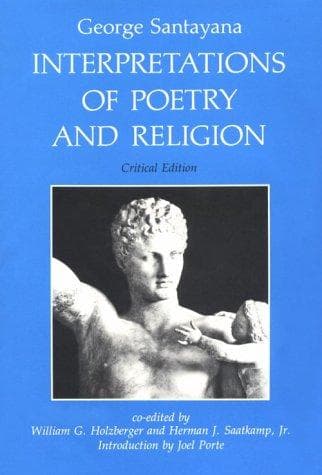
Interpretations of Poetry and ReligionSantayana, George
Religion
Interpretations of Poetry and Religion
Santayana, George
Aesthetics; Literature -- History and criticism; Poetry; Religion
The wildest fairy-story thus leads easily to a little drama not
without its human charm and moral inspiration; while the legend is
attached to the cultus, and the cultus is intertwined with the practice
and sanctions of daily life. Even here, in its most playful mood,
therefore, this mythological poetry retains the spirit and function
of religion. Even here sacerdotal interests are not forgotten. Delphi
shall be safe; the lyre is Apollo's by right although it be Hermes' by
invention. A certain amiable harmony is after all drawn from the riot
of foolishness. All is sweet and unmalicious and lovable enough, and
the patronage of both the friendly gods, the enthusiast and the wag,
may be invoked with confidence and benefit.
Not less remarkable, although for other reasons, is the hymn to
Aphrodite. Here we find a more human fable and a more serious tone:
while the poem, if we choose to consider it in its allegorical meaning,
touches one of the deepest convictions of the Greek conscience. All the
gods save three--Athena, Artemis, and Hestia,--are subject to the power
of Aphrodite, Zeus at least as much as the rest. In revenge for this
subjection, Zeus determines to make Aphrodite feel the passion which
she boasts to be able to inspire in others.
The fair shepherd Anchises feeds his flocks upon Mount Ida, and with
him Aphrodite is made to fall in love. She presents herself to him in a
human disguise, and meets his advances with a long account of her birth
and parentage, and begs him to take her back to her parents, and having
asked for her hand and fulfilled all customary formalities, to lead her
away as his lawful wife. The passion which at the same time, however,
she is careful to breathe into him cannot brook so long a delay: and
she yields to his impatience. When about to leave him she awakes him
from his sleep, turns upon him the full glance of her divinity, and
reveals her name and his destiny. She will bear him a son, Æneas, who
will be one of the greatest princes and heroes of Troy; but he himself
will be stricken with feebleness and a premature old age, in punishment
for the involuntary sacrilege which he has committed.
Public-domain text, read in full here on John Shaqi.
Reviews
Reviews
No reviews yet
Be the first to share your thoughts on this work.
Join the Discussion
Join the discussion
Sign in to leave a comment or review.
Sign InorCreate an account